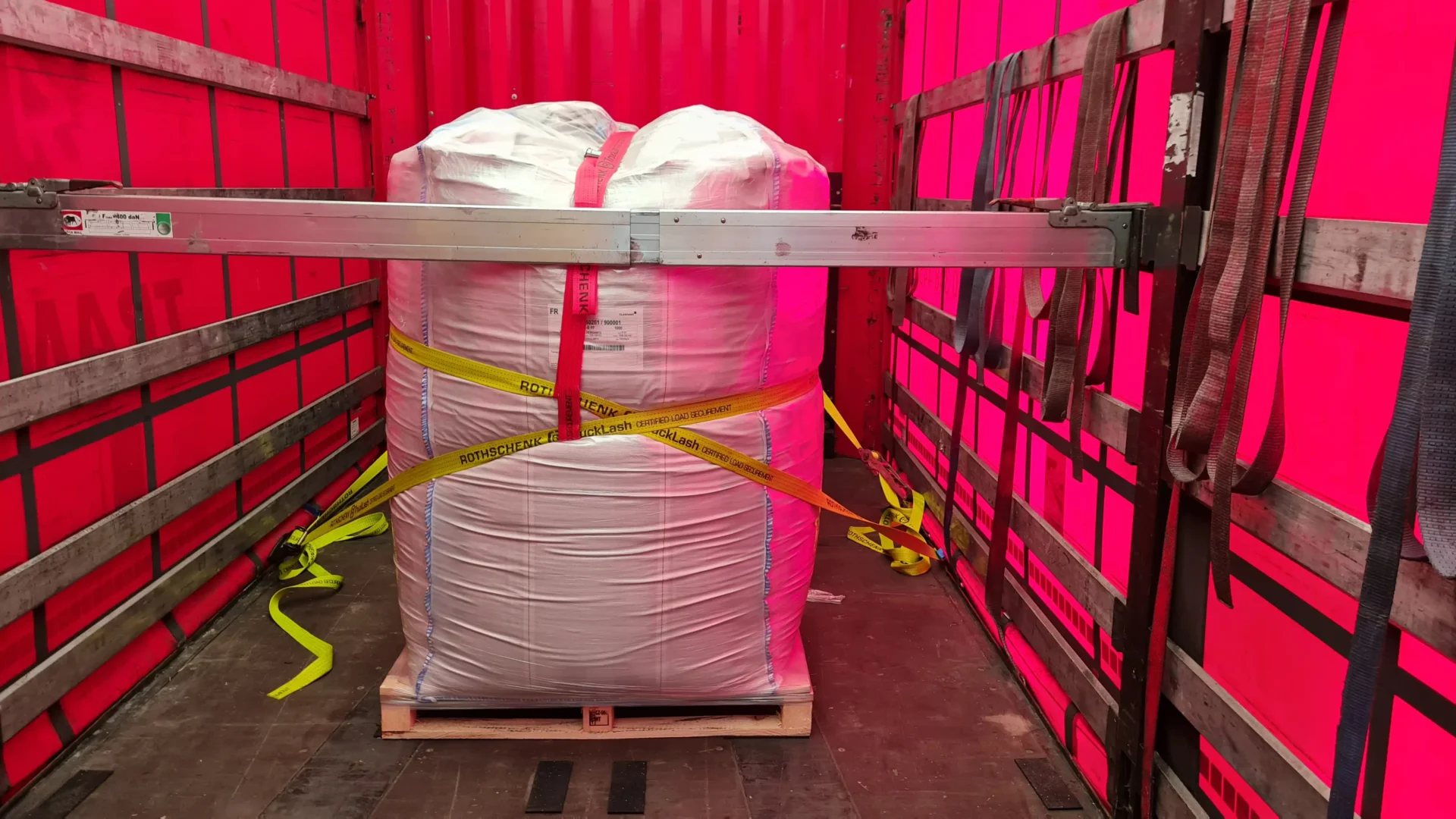


My esteemed colleague Christian Schmid told me about an incident that I took as the reason for the following article.
The incident in itself is nothing unusual, but actually only the consequence, because the inspection authority was not satisfied with the truck driver alone.
If the inspection authority were to do this more often, which would be desirable, then presumably more shipping companies would draw conclusions for improvements.
In the many years that I have been on the road as a consultant and trainer, I have only trained the employees at almost all companies who have brought the finished product to the customer. But that is just one of many other places where loading and transportation takes place.
I would like to illustrate this with the following diagram, where the red dash line represents the trip wires and the blue dash line the public area:

Transportation and storage within the factory premises must be carried out in accordance with the regulations of the employers’ liability insurance association. All other transports leaving the factory premises, regardless of by whom and to whom, must be carried out in accordance with the StVO & StVZO and, if applicable, the dangerous goods regulations.
In many companies, however, the focus of training and regulation is only on the transportation that delivers the finished product to the customer.
It would therefore make sense to record all transports that leave the factory premises. Here are a few tips:
With a little imagination, anyone looking through the lens described above will find other approaches in their own company.
Now briefly to the story that was the actual reason for this amount. A company transports parts from production to a partner company to have them processed there. As usual, the action bypasses the warehouse and logistics because it is a matter of production.
The inspection authority establishes the condition of the inadequate load securing and sends a hearing form to the contractor.
In the hearing form, the inspection authority asks the company:
The control authority attaches a note with the following content:
I would like to make it clear again at this point that the “shipper” before the law is not the well-known “forklift driver Klaus”, but the company, represented by the managing director or operations manager.
The inclined reader will now be able to understand that a certain amount of unrest is spreading in the company because the generally known “forklift driver Klaus” is suddenly no longer in the running, but his superior is. In the worst case, if points 1-5 cannot be conclusively explained, the entrepreneur himself. Unfortunately, I can say from experience that many companies would be left “empty-handed” in this case.
To avoid such unpleasant situations, it makes sense to transfer the graphic at the beginning of the article to your own company and look for comparable situations. Please keep in mind not only the truck, but also the car in which an employee quickly stows something in the back seat or the passenger seat to take it to a business partner or for private use.
If such situations are found, the points 1-5 mentioned by the inspection authority must be put into practice without delay, taking into account the instructions a-d. Controls cannot be prevented, but their negative effects can.
When considering this, please not only keep in mind the “point” in the Flensburg register and the €60, but also the criminal offense of negligent bodily injury and negligent homicide. Not to mention compensation for pain and suffering and/or restitution. All of a sudden, other sums of money are involved.
Add this article to your to-do list for 2026, it’s still early days and there are many opportunities for inspections, both internally and externally by the authorities.
In this context, I would like to refer to three works that deal with precisely this topic:
It’s worth browsing through it and putting the findings into practice. Tackle it, it can only get better!
With this in mind, I wish all readers a good start to the new year.
Yours, Sigurd Ehringer

<< Previous Post
Episode 63: Christmas special – keep your eyes open in traffic
To the next post >>
You are currently viewing a placeholder content from Vimeo. To access the actual content, click the button below. Please note that doing so will share data with third-party providers.
More InformationYou are currently viewing a placeholder content from YouTube. To access the actual content, click the button below. Please note that doing so will share data with third-party providers.
More InformationYou need to load content from reCAPTCHA to submit the form. Please note that doing so will share data with third-party providers.
More InformationYou are currently viewing a placeholder content from Google Maps. To access the actual content, click the button below. Please note that doing so will share data with third-party providers.
More Information