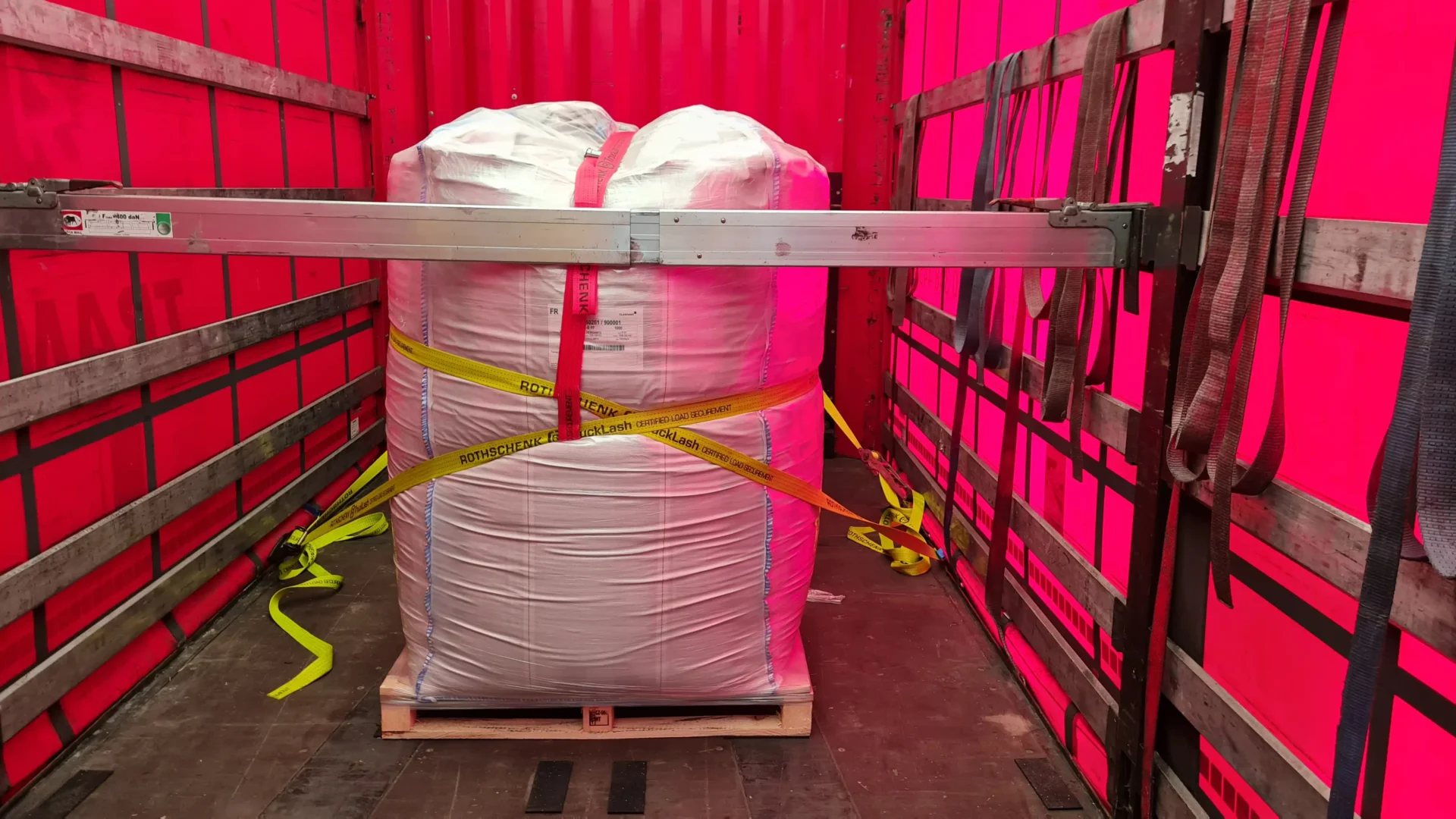


At a Glance:
This article explains how buckles work and their importance in packaging, as well as in securing load units and cargo. It explains the differences between breaking strength (BS), lashing force (LC), maximum service load (MSL), and system strength, noting that the weakest component always determines the permissible load capacity of the entire system.
Using the CTU code, this section demonstrates how the usable system strength can be derived from the breaking force and why it is crucial for safe design. Since there are no uniform regulations governing the labeling of buckles, manufacturers’ specifications should be carefully reviewed, and any ambiguities should be clarified directly with the manufacturer.
Today’s post will focus on the topic of “straps.” These are products that come in a wide variety of types and are used in various fields, including packaging, loading units, and load securing. Unfortunately, however, there is little information available on this topic; even when it is available, it is hard to find and often not very informative. With this post, I’m trying to remedy that situation.
First, what is a buckle? According to Wikipedia, it is a clasp with one or more prongs. The prongs are attached to a belt. One end of the belt is threaded through this bar. The prongs are either pushed through or threaded through existing holes, which prevents the belt from slipping. Most pants belts work according to this principle.
Buckles have been known since Roman times and are an important archaeological find.
Based on their characteristic features, they can be attributed to specific population groups or a particular era.
That’s an interesting topic in and of itself.
Image source: https://de.wikipedia.org/wiki/Schnalle#/media/Datei:G%C3%BCrtelschnalle.JPG

The main function of a buckle, then, is to connect the two ends of a strap or band and prevent them from slipping apart.
This property is utilized in packaging, as well as in securing load units and cargo. However, it is precisely in these areas that evidence is required to demonstrate whether the method can withstand the forces that occur or are expected to occur. Thus, two elements (the buckle and the strap) are combined into a single system, giving rise to the term “systemstrength.”
Anyone who takes the time to do some research—for example, using Google—will quickly discover that many providers leave those seeking answers with inaccurate information or platitudes. What good is the statement “50% better” if the baseline figure for the calculation is missing? They’ll ask themselves, “So what?”
We therefore need to explain various terms that are important in this context.
Breaking Strength (BS ) = Breaking Load (BL): This is the maximum force required to destroy a component or cause permanent deformation. The stages leading up to fracture are often elastic elongation and permanent deformation.
Lashing Capacity (LC ): This is the force required to compensate for the forces acting on the cargo (e.g., due to acceleration). It always includes a safety factor.
Service Load (MSL = Maximum Securing Load): This is the force that must be taken into account when only the breaking load is specified for a component. The MSL therefore includes a safety factor to account for unforeseeable situations.
For components (e.g., tension straps) for which an LC value is specified, this value corresponds to the MSL
System strength: This is the maximum force that must be taken into account when connecting components with different force ratings. In this case, you must determine which component has the lowest force rating. That value then represents the system strength. I would like to illustrate this concept with a few examples. These are fictional.
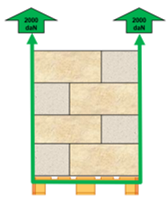
Let’s assume we have a load of 1,000 kg that is to be secured to the load carrier with webbing. The breaking load (BS = BL) of the webbing is 2,000 daN.
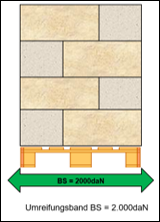
Based on the pulley principle, a force of 2,000 daN could be applied at both ends.
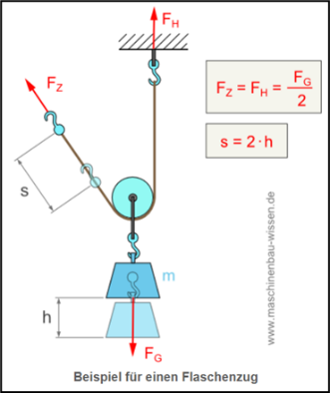
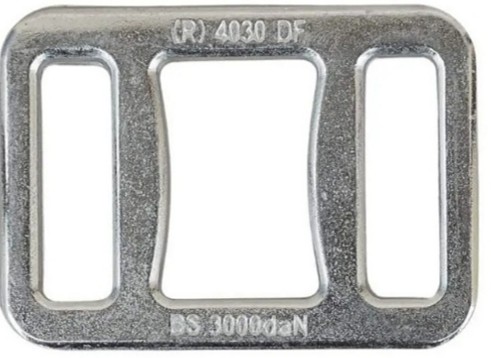
The strap must be attached to a buckle with a breaking load (BS) of 3,000 daN.
There are various sets of regulations governing load securing. The main ones are VDI-2700ff (national) and the CTU Code 2015 (international), which address this topic.
The best source is the CTU Code, primarily because it is publicly available. Appendix 7, Chapter 2.4, “Lashing Materials and Equipment,” contains more detailed information on this topic. Chapter 2.4.2 includes a table showing the relationship between breaking strength and MSL. Unfortunately, the buckle is not included in this overview. However, one could apply the specifications for shackles, rings, or lashing eyes. The MSL is set at 50% of the breaking strength of these components.
The MSL of this buckle, with a BS of 3,000 daN, would therefore be 1,500 daN. This means that the system strength that can be relied upon is 1,500 daN.
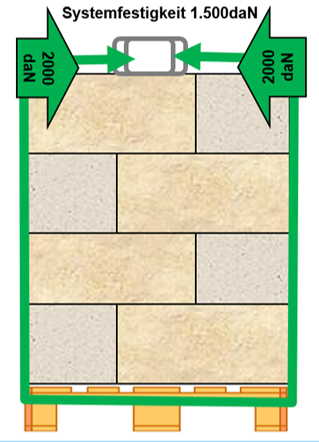
With this information in mind, it is now necessary to determine, in this specific case, whether the actual forces that arise in conjunction with acceleration can be compensated for. It may be necessary to use two such systems to secure the loading unit correctly in accordance with the regulations.
Unfortunately, there are no universal regulations governing the labeling of buckles. Each manufacturer has some leeway. For example, if a manufacturer specifies a tensile strength of 16 kN for straight tension and 32 kN for strapping, it’s unclear what exactly they mean by that. Is it the LC, the BL, or the MSL? In such cases, it’s best to contact the manufacturer or supplier directly to clarify the specifications.
The requirements of EN 12195-2 apply only to the labeling of lashing straps, but not to the wide variety of other buckles used in the packaging and container industries.
The saying, “A chain is only as strong as its weakest link,” sums it up perfectly.
If any of my readers happen to know of a source for further information, I would kindly ask them to share it with me. Thank you in advance.
As always, my remarks are intended only to touch on the subject, not to cover it exhaustively. Those who familiarize themselves with the task at hand may find their own solutions that are simpler and better. Doing nothing is the only thing that increases the overall risk for everyone involved during the transport phase. This should be avoided at all costs.
Tackle it, it can only get better!

<< Back to the previous post
Episode 69: Securing Methods: Lashing Down – The Thing About the Lashing Angle…
To the next post >>
You are currently viewing a placeholder content from Vimeo. To access the actual content, click the button below. Please note that doing so will share data with third-party providers.
More InformationYou are currently viewing a placeholder content from YouTube. To access the actual content, click the button below. Please note that doing so will share data with third-party providers.
More InformationYou need to load content from reCAPTCHA to submit the form. Please note that doing so will share data with third-party providers.
More InformationYou are currently viewing a placeholder content from Google Maps. To access the actual content, click the button below. Please note that doing so will share data with third-party providers.
More Information