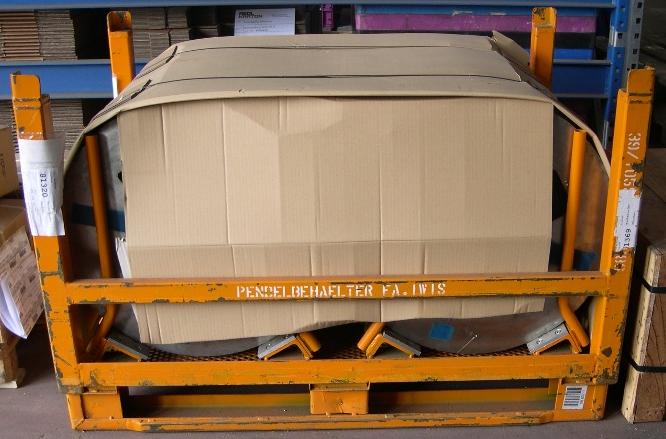



At a Glance:
This article highlights the simple tools and methods that can be used to address the challenge of stress-resistant packaging and find company-specific solutions.
What exactly is shipping damage? The various perspectives on the risks are supplemented with proposed solutions.
Movement of the cargo inside the packaging can cause damage during transport, but this damage is often not visible at first glance. That is why it is advisable to conduct a thorough inspection of every incoming shipment.
“According to estimates by the German Insurance Association (GDV e.V.), approximately 70% of all transportation damage worldwide is preventable, with a significant portion directly attributable to unsuitable or defective packaging.”
Source: GDV (German Insurance Association)
Based on my nearly 30 years of experience, I can wholeheartedly agree with that.
The question that naturally follows is: under what conditions would I consider damage to the goods to be the result of transportation? Here’s an example: A pallet of cement bags is delivered from the manufacturer to the recipient, and one bag is damaged during transport.
If the recipient is a home improvement store, they will file a claim for damage in transit because the damaged bag can no longer be sold. If, however, the recipient is a construction site, they will likely just dump the bag into the mixer and not make a fuss about it. So it depends on the circumstances as to when something is considered damage in transit.
During various conversations with customers, the topic of “shipping damage” came up time and again. When I asked whether there was any shipping damage and, if so, how much, I was often told there was none or none worth mentioning. When I asked the second question—whether there was a company-specific definition of damage during transport—I was usually met with silence.
My view is this: if there is no company-specific definition of transport damage, then it cannot be specifically documented. It is therefore up to the observer to decide whether or not damage is present.
“If goods are damaged in transit because they were not packaged ‘appropriately for the intended use,’ this has serious implications for insurance coverage and the liability of all parties involved.” So states the GDV.
In our bureaucratic German system, one can assume that everything is regulated somewhere—you just don’t know exactly where. The German Commercial Code (HGB) provides clarity on this matter.
For once, here is the original text of the law:
The shipper must pack the goods—insofar as their nature requires packaging in light of the agreed-upon mode of transport—in such a way that they are protected against loss and damage and that no damage is caused to the carrier. If the goods are to be handed over for carriage in a container, on a pallet, or in or on any other loading unit used to consolidate cargo items, the shipper must also stow and secure the goods in or on the loading unit in a manner that ensures they are safe for transport. The shipper must also mark the goods to the extent required for their handling in accordance with the contract .
§ 411 Packaging. Marking
And here’s another section of the law:
(1) The carrier is exempt from liability to the extent that the loss, damage, or failure to meet the delivery deadline is attributable to one of the following risks:
§ 427 Special Grounds for Exclusion of Liability
1. the agreed-upon or customary use of open vehicles not covered by tarps or loading on deck;
2. insufficient packaging by the shipper;
3. handling, loading, or unloading of the goods by the shipper or the consignee;
4. the natural nature of the goods, which is particularly prone to damage, especially due to breakage, rust, internal spoilage, drying out, leakage, or normal shrinkage;
5. insufficient marking of the cargo items by the shipper;
6. the carriage of live animals.
From these two paragraphs, the following interrelated considerations can be derived, among others:
Step 1: Definition of transport loads
Step 2: Determining packaging suitable for the loads
Step 3: Instructions for forming stable load units
Step 4: Instructions for securing the load unit on or inside the transport vehicle.
In the following posts, I will examine each of these steps and share my thoughts on them.
Step 1: Defining Transportation Demands
A customer orders a product from a supplier and provides a shipping address. From this, the expected transportation demands can be determined.
Example: The production facility for the desired product is located in Germany, and the recipient needs the goods delivered to their location in Australia. The question is: Which transportation routes can be used to get the product to Australia? The only options are by ship or by plane. This allows us to determine the transportation impacts more precisely. Please follow my reasoning.
Air Transport:
Ship as a Means of Transportation:
The following graph illustrates the expected loads on a ship, for example:
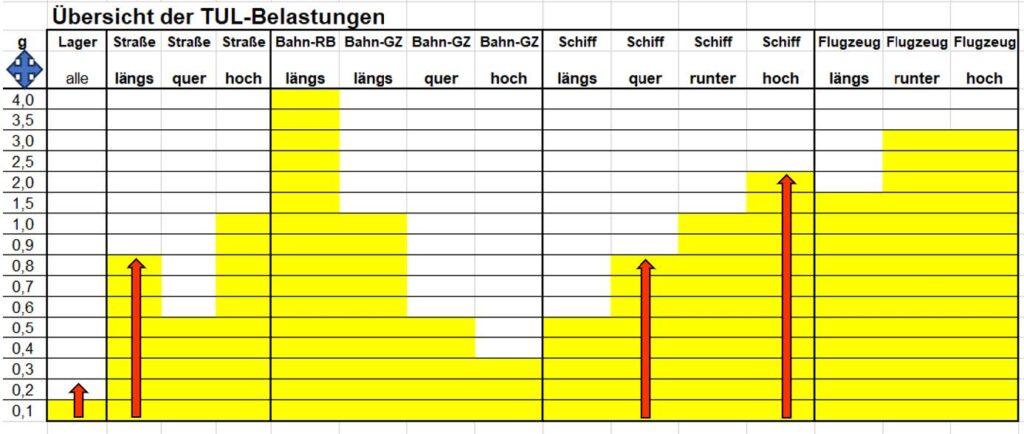
It can be seen that, on the road, emergency braking at 0.8 g must be taken into account, while on a ship, rolling motion at 0.8 g and stack pressure at 2 g must be considered.
This means that both the product packaging and the securing of the load units must be designed to withstand these loads. The 0.8 g rolling motion on the ship corresponds to a roll angle of ~38 degrees with a period of 2–3 times per minute. The two screenshots from a video are intended to illustrate this issue.
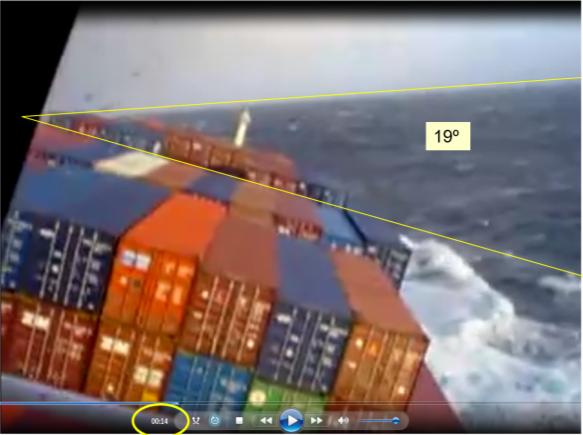
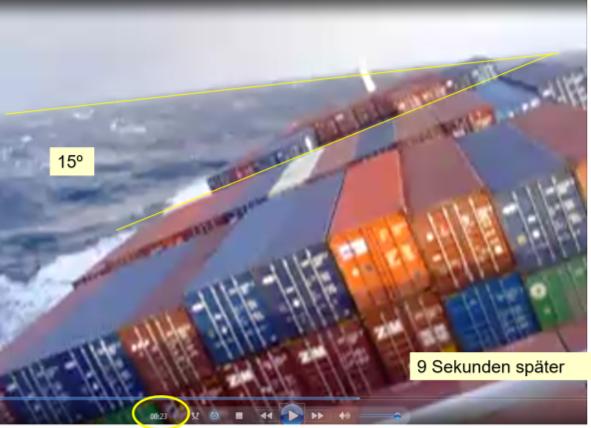
A product that has room to move inside its packaging will shift and slide back and forth with every roll of the ship.
The stacking compression force of 2 g occurs when the ship pitches, at the moment the load shifts from top to bottom. The farther a container is from the ship’s roll axis, the greater the stacking compression force becomes. As a rule, the shipper has no influence over where the container is stowed.
Anyone who paid attention in school knows about Sir Isaac Newton and some of his laws. Without going into detail and to put it simply, the law is Force = Mass × Acceleration, and the state of rest is defined as Force a – Force b = Zero.
Forces always act on the center of mass. If a package contains multiple products, each has its own center of mass where forces act. Only proper packaging combines the various centers of mass into a single center of mass for the package.
From this, the following consideration can be derived.
Packaging is considered suitable for the intended use if:
1. The product(s) cannot move inside the packaging because the centers of gravity of the packaged products merge with the packaging material to form a single center of gravity
2. When the packaging as a whole can compensate for the expected loads in all directions
3. if the loading unit behaves as a single unit with a single center of gravity during the transport and handling phases.
4. If the packaging or loading unit is designed to also compensate for expected stacking pressure.
From this perspective, every manufacturer/shipper is required to more accurately record and define the stresses on its products and the modes of transport used. It may be necessary to take certain stresses into account as early as the design phase—for example, stresses that occur during normal handling and use, and, of course, during the transport phase. If goods are packed in cartons and are to be stacked on a pallet, the maximum allowable stacking factor must be determined. If, for example, the loading unit is to be stacked again inside a container to make full use of the available transport space, this must also be taken into account.
When selecting cardboard material, the potential stacking factor must be taken into account, or auxiliary materials (e.g., square timbers, etc.) must be included in the packaging to compensate for this.
In the next installment, I will explain the individual elements and causes related to Level 2 in greater detail.
As always, my descriptions are only intended to outline the topic, but not to cover it exhaustively. If you familiarize yourself with the task, you may find solutions that are simpler and better. Simply doing nothing increases the general risk during the transportation phase for everyone involved and this should be avoided at all costs.
Tackle it, it can only get better!
Yours, Sigurd Ehringer
<< Back to the previous post
Episode 73: Loading Racks, Storage Racks, Transport Racks

You are currently viewing a placeholder content from Vimeo. To access the actual content, click the button below. Please note that doing so will share data with third-party providers.
More InformationYou are currently viewing a placeholder content from YouTube. To access the actual content, click the button below. Please note that doing so will share data with third-party providers.
More InformationYou need to load content from reCAPTCHA to submit the form. Please note that doing so will share data with third-party providers.
More InformationYou are currently viewing a placeholder content from Google Maps. To access the actual content, click the button below. Please note that doing so will share data with third-party providers.
More Information