


At a Glance:
Language barriers in logistics can lead to misunderstandings and safety risks.
Existing language skills within the company help break down these barriers in a targeted manner.
Workflows should be broken down into simple steps and supplemented with images and multilingual instructions.
Practical solutions can be developed together with employees and continuously improved.
Who isn’t familiar with the story of the Tower of Babel, which could not be completed because of the confusion of languages created by God?
Who isn’t familiar with the story of the Tower of Babel, which could not be completed because of the confusion of languages created by God?
If you look around at logistics today, many situations seem familiar, and you’re reminded of the Tower of Babel. Here, too, things go wrong here and there because of the language barrier, and only a few tackle the problem and look for solutions. There is no “one” solution, but rather methods that every company should consider in order to adopt a version tailored to its needs. In the following, I’d like to share a few thoughts and suggestions on this topic.
No company today can do without employees whose native language is not German.
A first step, then, would be to identify which native languages are already present in your own company—at all levels. You’ll be surprised by the number. This already provides a foundation for solving the problem. Someone who speaks the native language has an easier time than any translation app because they also understand the context of the problem.
The second approach would be to narrow down the area in which the language barrier is to be eliminated or reduced. Not every tool or method is suitable for every area. Where digital resources are limited or unavailable on-site, a digital solution cannot be implemented.
The third approach involves developing a process description for which language instruction is to be designed.
The main task is to break the process down into small, manageable steps so that it can be described in simple, short sentences. Ideally, these steps are supplemented with images or graphics, following the adage that a picture is worth a thousand words. It can be helpful to specifically illustrate and photograph individual steps so that the user can understand the purpose of the instructions. It’s important to involve employees who are unfamiliar with the process to avoid mental shortcuts that might arise because the developer is already familiar with it.
The individual steps (=thin slices) must build logically on one another and lead to a verifiable whole. This applies to all areas, regardless of the subject matter.
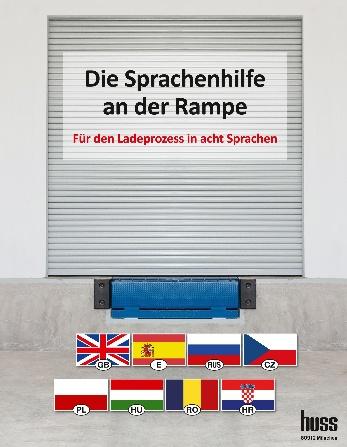
As inspiration for this method, I would like to mention the book shown here. Here are two excerpts from it.
The loading process consists of individual steps/actions.
The left column contains the German text, and the middle column contains the foreign-language text. The third column contains the corresponding image.
The text can be combined with the same image to create different variations.
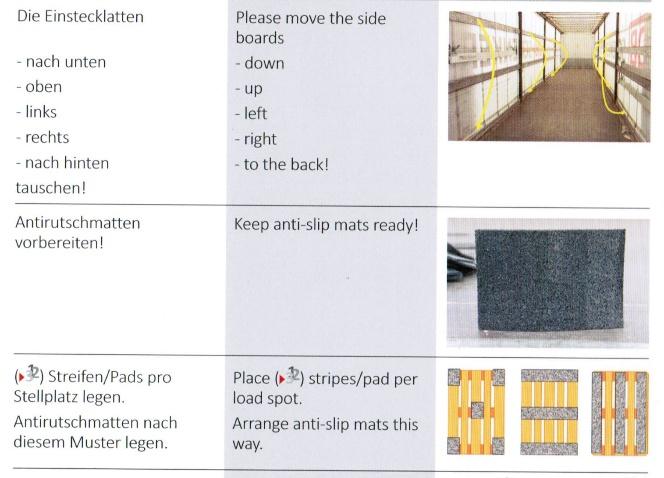
To add another foreign language, simply update the middle column.
The simple texts can be translated by employees who are already part of the company. So it’s a relatively small effort.
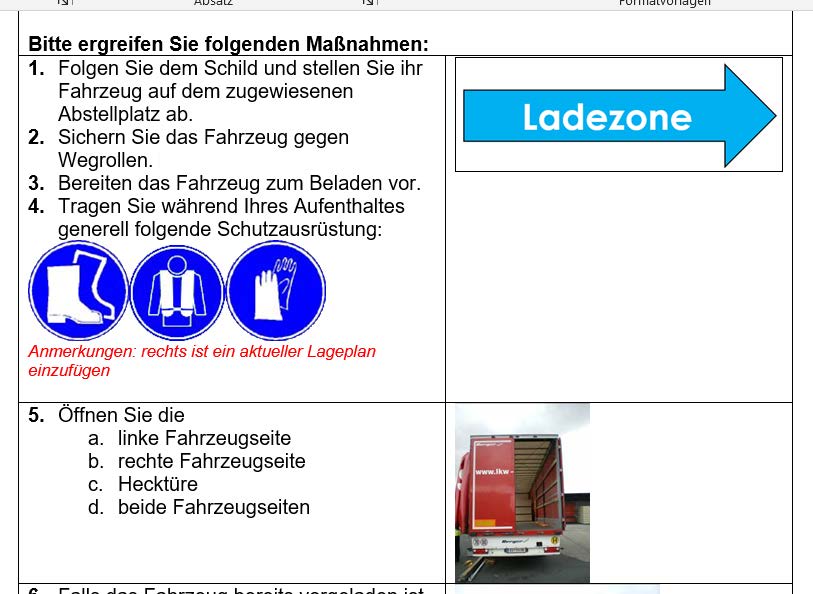
Here is another example of how to encourage drivers to behave appropriately on company property.
In this case, the entire set of instructions is displayed in various languages and handed out to drivers at the gate.
So it’s not about waiting until the perfect solution comes to mind, but rather tackling the problem and developing an approach that can then be refined over several rounds.
A 90% solution is better than waiting forever for “divine inspiration” for the 110% solution.
Involving employees also has the advantage of motivating them to think in the company’s best interests and to collaborate on the solution.
Improvements and changes can be made quickly at any time because employees are available and there’s no need to accommodate external schedules.
As always, my explanations are intended only to touch on the topic, not to cover it exhaustively. Those who familiarize themselves with the task at hand may find solutions that are simpler and better. Doing nothing is the only thing that increases the overall risk for everyone involved during the transport phase, and that should be avoided at all costs.
Get to work—things can only get better!
Yours, Sigurd Ehringer
<< Back to the previous post
Episode 71: How to Secure Big Bags Reliably in a Truck

You are currently viewing a placeholder content from Vimeo. To access the actual content, click the button below. Please note that doing so will share data with third-party providers.
More InformationYou are currently viewing a placeholder content from YouTube. To access the actual content, click the button below. Please note that doing so will share data with third-party providers.
More InformationYou need to load content from reCAPTCHA to submit the form. Please note that doing so will share data with third-party providers.
More InformationYou are currently viewing a placeholder content from Google Maps. To access the actual content, click the button below. Please note that doing so will share data with third-party providers.
More Information