

Auf einen Blick:
Sprachbarrieren in der Logistik können zu Missverständnissen und Sicherheitsrisiken führen.
Vorhandene Sprachkenntnisse im Unternehmen helfen dabei, diese Barrieren gezielt abzubauen.
Arbeitsabläufe sollten in einfache Schritte zerlegt und durch Bilder sowie mehrsprachige Anweisungen ergänzt werden.
Praktische Lösungen lassen sich gemeinsam mit den Mitarbeitern entwickeln und kontinuierlich verbessern.
There are already quite a few posts on the topic of “problem shipments,” and today I’d like to focus on big bags/FIBCs. FIBC stands for Flexible Intermediate Bulk Container.
The big bag is the most widely used type of loading unit for transporting flexible bulk materials. Translated into German, it means a large bag, sack, or pouch.
The differently shaped filling opening and the carrying loops are located at the top.
Various standards, such as VDI-2700ff, EN-12195-1, and the CTU Code 2014, specify acceleration values for road, rail, and sea transport that must be taken into account when securing cargo.
The goal of any method of securing a load unit is to use various means and methods to combine individual packages or partial loads—each of which has its own center of gravity—into a single load unit with a single center of gravity.
It is precisely this circumstance that creates the problem with big bags: the usual means and methods cannot be applied without further ado. A gap remains in terms of creating a stable loading unit. This gap can only be closed with a suitable means of transport.
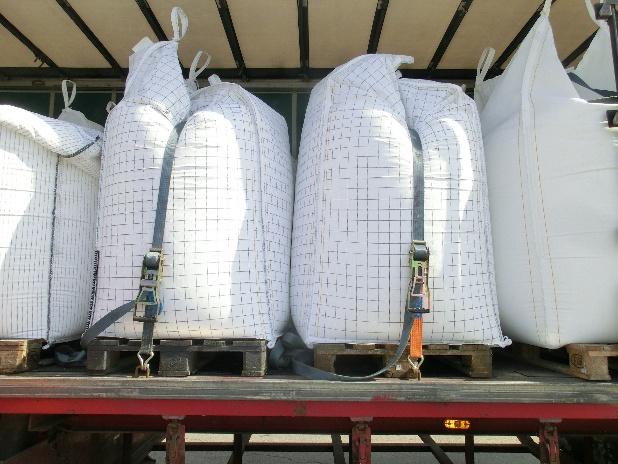
The image shows how the contents of the big bags give way to the preload exerted by the straps and shift.
If a securing force was actually generated at the time of loading, it will diminish or disappear entirely after just a short distance.
As a result, the load is no longer secured.
The picture shows that a securing device—in this case, a clamping board—that applies force only at specific points or over a small area is unsuitable for big bags.
A Euro pallet standing on end in front of it would have significantly improved the effectiveness.
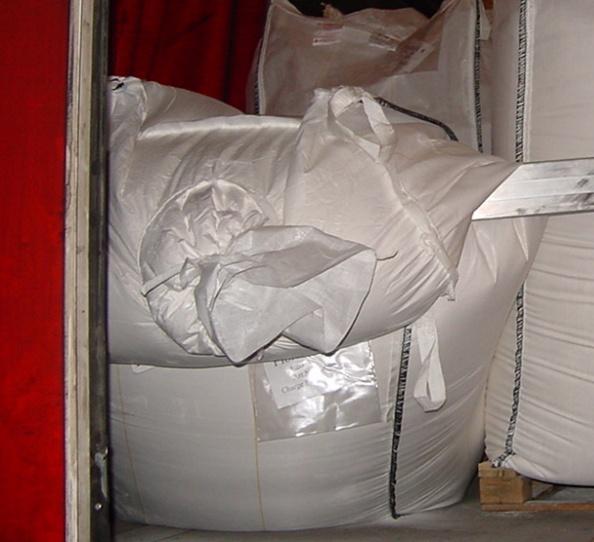
A big bag is considered a problem load when its specific design does not correspond to the mode of transport.
In the meantime, VDI-2700 Sheet 18, “Securing Bulk Goods in Flexible Packaging,” has been published. It contains many examples of various use cases that are certainly worth noting. It addresses the problem once it has already arisen. My approach is to prevent the problem from occurring in the first place. In any case, the responsibility for proper load securing remains with the shipping company.
In my view, there are two different ways of looking at this:
1. The means of transport has been arranged, and it must be determined whether the FIBCs to be transported can be safely moved from A to B in accordance with the regulations. This would be the perspective of the freight forwarder or carrier.
2. The FIBC is provided, and it must be determined which mode of transport and the resulting additional measures will ensure that the cargo can be transported safely. This is the shipper’s perspective.
The second option is probably the most common, which is why I’d like to elaborate on it further. The starting point for these considerations is the purchase of the big bags. Even at that stage, the purchasing department can either create or avoid problems.
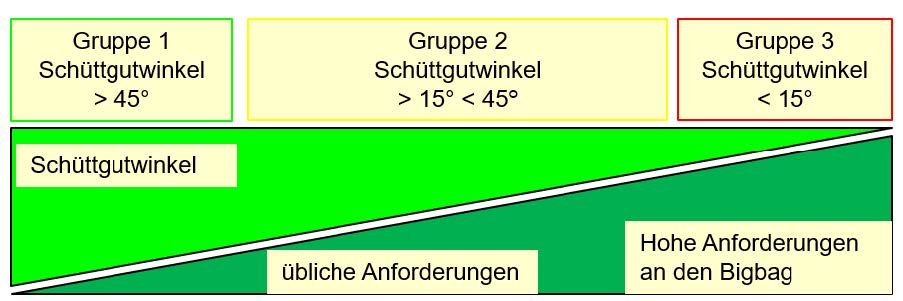
Before making a purchase, it is essential to check two key criteria: the angle of repose and the settling behavior of the material being transported. The flatter the angle of repose and the greater the settling behavior, the more robust the big bag must be designed.
The chart is intended to illustrate the relationship:
My friend Professor Podzuweit has discussed some interesting aspects of this topic (Load Securing in Big Bag Transport, Study on the Shifting of Bulk Loads, Prof. Ulrich Podzuweit 2013), which I would like to summarize here.
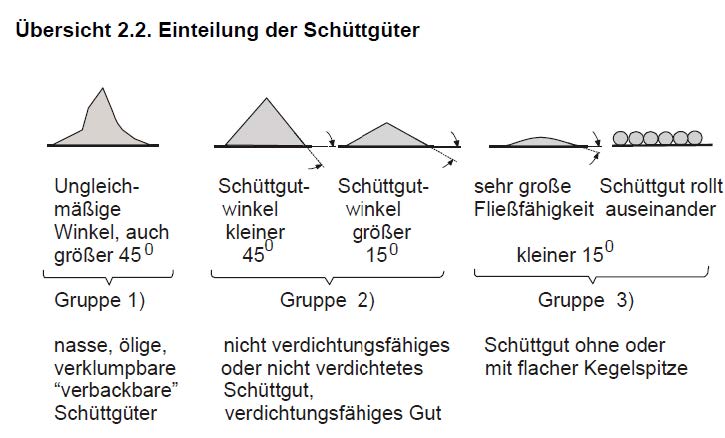
Group 1 bulk materials are materials that tend to “clump” or “cake” when moisture is added (e.g., dextrose with 5% moisture), when oil is added, or for other reasons (loading, . . .).
Group 2 bulk cargoes with a bulk angle close to 45 degrees can generally be secured in the same way as “normal” cargoes, especially if they are compactable and remain compacted during transport.
Group 3 materials tend to behave more like liquids and, even when packaged in elaborate big bags, are often not dimensionally stable—or not sufficiently so—making them costly to secure. Custom solutions must be developed for them.
He also defined the exemplary configurations that correspond to the diagram above, from left to right:
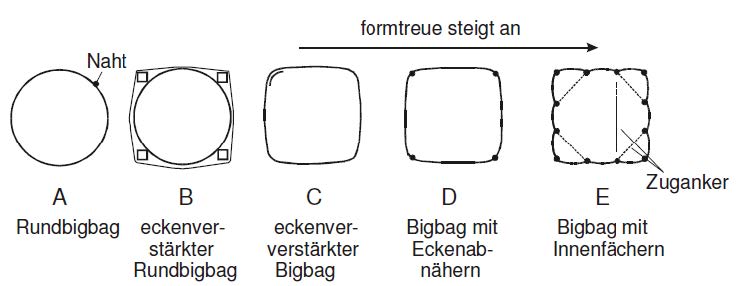
The first step in ensuring trouble-free transport must be to determine the angle of repose and the settling behavior of the bulk material. This determines the selection of the appropriate big bag design. It follows that the flatter the angle of repose, the higher the quality of the big bag must be.
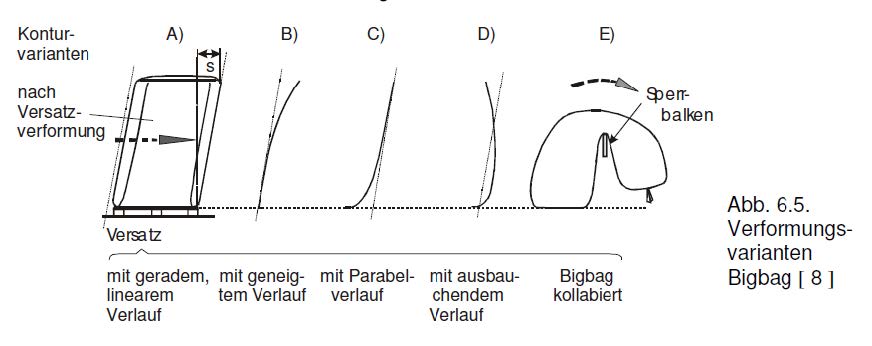
Another option is to perform a tilt test to determine the tilt angle α (tanα = acceleration) at which the big bag changes shape to the point that it becomes unstable. According to Podzuweit, the following types of deformation can be expected:
I described how to perform the tilt test in Episode 55.
The smaller the tilt angle at which deformation begins, the more unstable the loading unit is.
Another way to avoid problems is to choose the right load carriers. The aspect ratio should be adapted to the mode of transport. A big bag on a 114×114 cm container pallet in a truck with a loading width of 240 cm already causes problems simply due to the technical gaps.
This should be taken into account in advance.
Once the decision has been made and the big bag has been selected, you can start thinking about the mode of transport. In many cases, a vehicle with a box body will cause fewer problems than one with a sliding tarp.
In general, the use of the low-lashing technique is not very promising. This is especially true for cargoes whose angle of repose tends to be below 45° and closer to 15°. The cargo yields to the applied pretension, shifting away from it, causing the pretension to be lost and thus leaving the load unsecured. Even aids such as cardboard strips, deck pallets, etc., do not satisfactorily solve the problem. This leaves only the option of form-fit securing.
If there are gaps between the big bags or between them and the side walls of the transport vehicle, these gaps can be reduced or closed by placing pallets on end.
If we are loading the box-body vehicle from the rear, we should first stow the big bags and then place the pallet in the remaining space.
Especially when the big bags don’t quite fill the pallet.
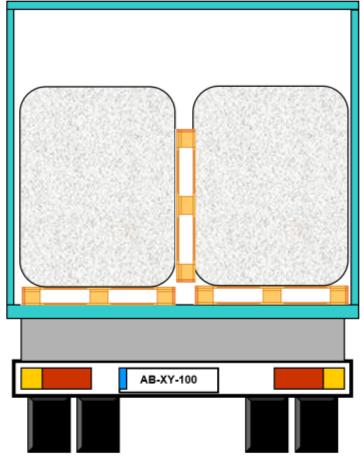
If the sliding tarpaulin body is loaded from the side, it is best to first stow the empty pallet on its edge and then push the pallets with the big bags up against it.
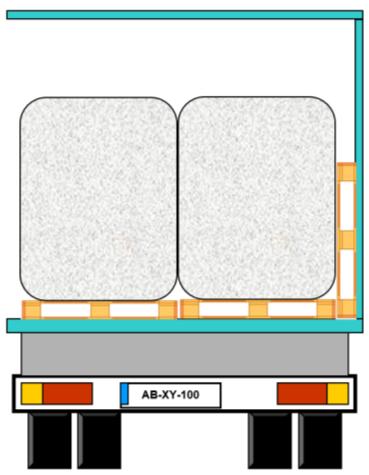
This illustrative diagram is intended to show how difficult it is to properly secure big bags that do not fill the loading container.
Therefore, it is important that the dimensions of the big bags be adjusted to fit the loading container.
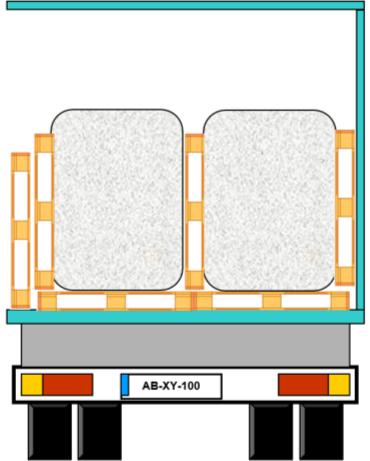
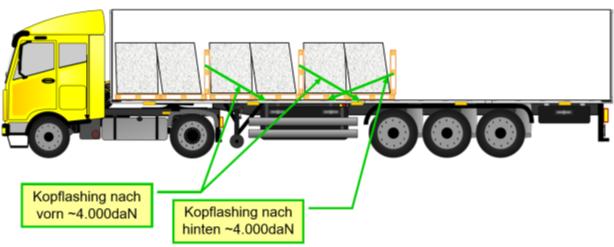
Individual or a small number of big bags can be secured using head flashing with pallets standing on end. The pallets distribute the force of the straps across the surface of the big bags. So-called compartments can be formed by grouping several big bags together into a single load unit. The formation of compartments is also recommended in VDI-2700 Sheet 18.
For full truckloads, it may be advisable to install an intermediate securing measure—using head flashing with pallets placed on their sides—after every 2/3 of a loading row.
The graphic is intended to illustrate, by way of example, how during an emergency stop the gaps in front close up while those behind grow larger and larger.
It may not be possible to unload the last few rows of cargo without some difficulty.
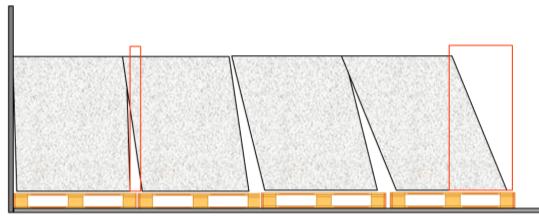
One possible solution would be to flash the head forward every second, third, or fourth row of cargo. This depends on the stability of the loading unit.
The deformation behavior of the big bags starts over from the beginning and remains within manageable limits.
The use of slip-resistant materials between the truck bed and the loading unit, or between the load carrier and the big bag, should be viewed with caution. The smaller the angle of repose, the more likely the big bag is to deform before frictional forces come into play. In many cases, a certain form-fit develops between the big bag and the load carrier when the bottom of the big bag deforms and fills the gaps between the pallet’s deck boards. When accelerated, the big bag is more likely to tip off the pallet than to slide down it.
As is so often the case in life, the answer is: it depends on the circumstances.
Various manufacturers offer securing systems. These must be adapted to the big bags as well as the dimensions of the cargo hold. Therefore, they are only practical if the transport conditions are consistent enough to allow the systems to be reused. This limits the choice of carriers.
As always, my descriptions are only intended to outline the topic, but not to cover it exhaustively. If you familiarize yourself with the task, you may find solutions that are simpler and better. Simply doing nothing increases the general risk during the transportation phase for everyone involved and this should be avoided at all costs.
Tackle it, it can only get better!
<< Back to the previous post:
Episode 70: Seat Belt Buckles – How Well Does the System Hold Up, and What Is Its Weakest Link?

You are currently viewing a placeholder content from Vimeo. To access the actual content, click the button below. Please note that doing so will share data with third-party providers.
More InformationYou are currently viewing a placeholder content from YouTube. To access the actual content, click the button below. Please note that doing so will share data with third-party providers.
More InformationYou need to load content from reCAPTCHA to submit the form. Please note that doing so will share data with third-party providers.
More InformationYou are currently viewing a placeholder content from Google Maps. To access the actual content, click the button below. Please note that doing so will share data with third-party providers.
More Information