

In today’s article, I would like to tackle another problem – the barrel. Every soccer player knows that the “round must go into the square”. They have comparatively similar problems with it as the shipper and packer.
The barrel is one of the oldest transportation containers and, according to Wikipedia, was invented by the Celts. The Roman Pliny described the barrel made of staves as early as 50 BC. Even back then, the transportation, loading and unloading of barrels was a difficult undertaking for winegrowers and brewers.
The solution was the profession of the shooter or barrel puller. These people were specially tasked with handling the barrels from the cellar to the means of transportation and vice versa. The so-called shot ladder, a special tool for the heavy barrels, was used for this purpose. So there were specialists at work!
And today? The barrel is still causing problems and the shot ladder has been forgotten.
The core problem is the tight connection between the round barrel and the square load carrier.
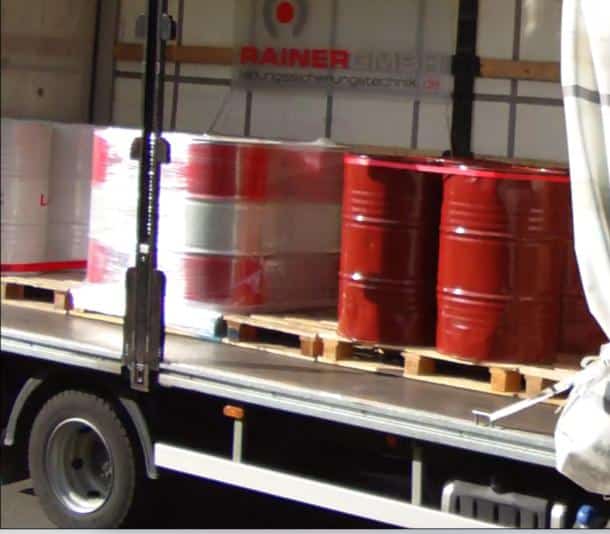
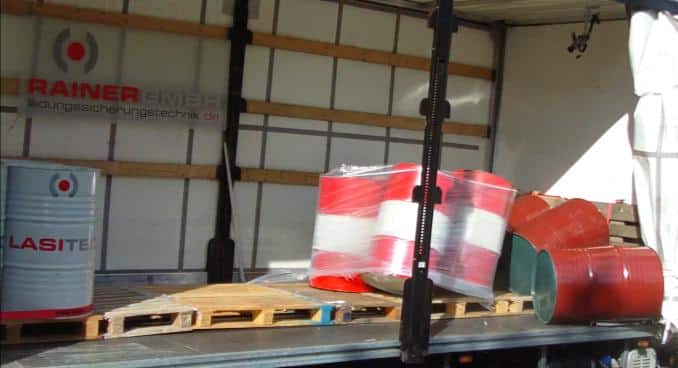
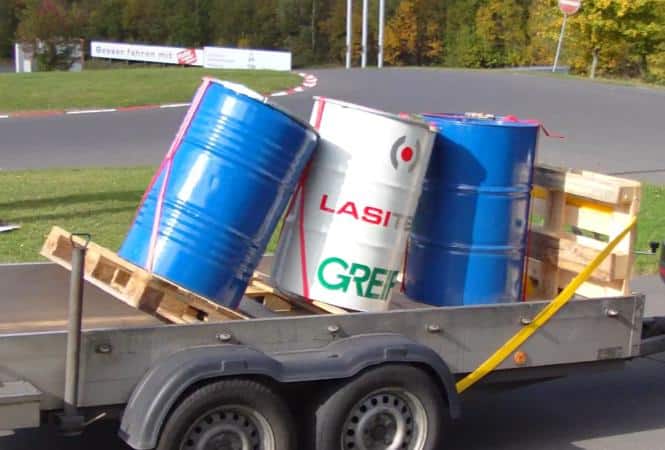
The following pictures from a road test are intended to illustrate the problem.
This screenshot of a road test shows the situation before braking.
The red drums on the right are only secured to the pallet with a belly band.
The red and white drums in the middle are connected to the pallet with a lot of stretch film.
The white drums at the back left are secured with a drum star.
The screenshot after braking.
The red barrels on the right break up and leave the load carrier individually.
The red drums leave the pallet as a block because the film tears off at the edge of the pallet. However, they are held together by the stretch film.
The white barrels on the far left of the picture are still in the same place.
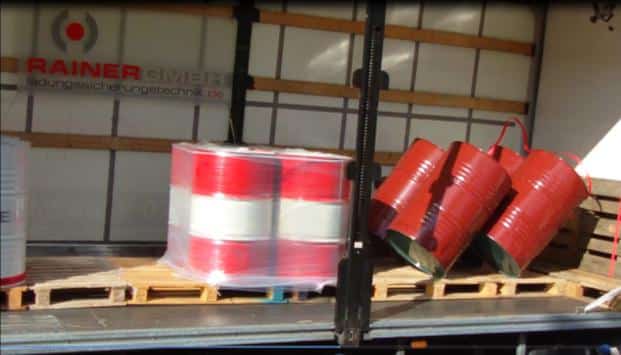
The free spaces created when the load is shifted cause the load units to disintegrate completely.
Even the red barrels secured with stretch film.
Only the loading unit secured with the barrel star on the left remains unchanged.
This screenshot shows that loading units with a single barrel, even if well secured, are not stable against tipping.
This must be taken into account when securing the load on/in the means of transport.
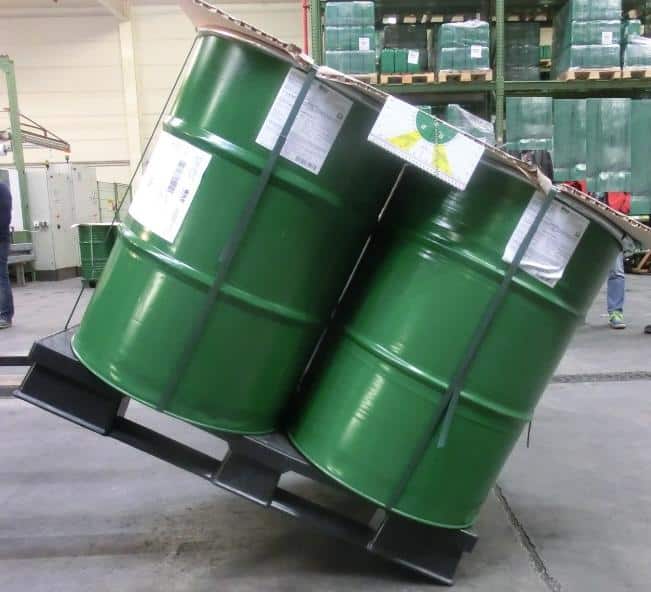
The tilt test, which can be carried out with “on-board equipment”, is a good way of testing the appropriate securing method for the situation.
The effectiveness of the method can be determined by changing the tilt angle.
The better the fuse, the higher the tilt angle.
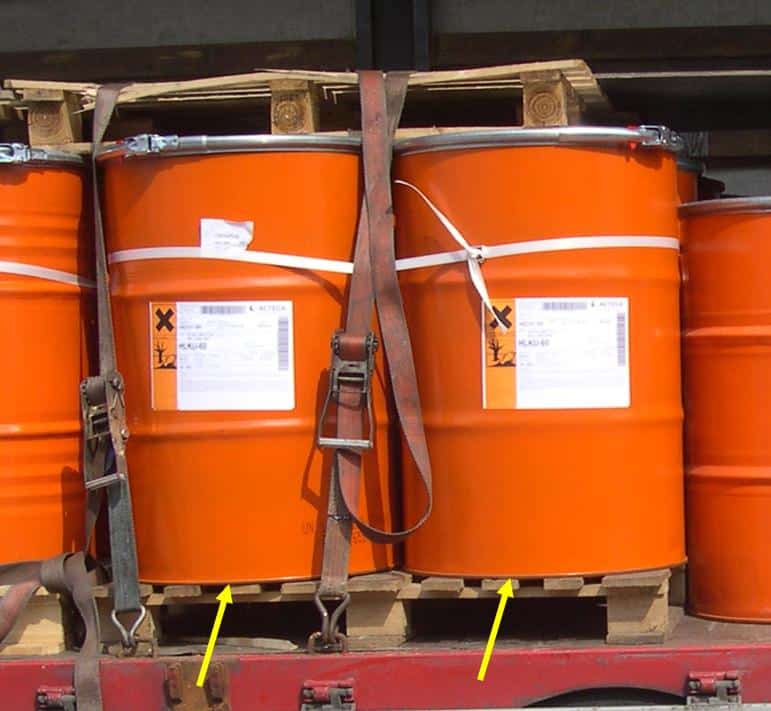
These drums stand loose on the load carrier. The white belly band is only used to secure them during transportation with a forklift truck.
It is not a load securing device.
Lashing down with straps across the pallets is also improperly executed because the top pallet yields to the pre-tensioning force.
In the event of full braking, the barrels would behave like billiard balls and compact as much as the free spaces allow.
In the event of an emergency stop, this barrel would most likely come loose and move to the next obstacle.
A non-slip pallet support would ease the situation considerably, but would not solve the problem permanently.
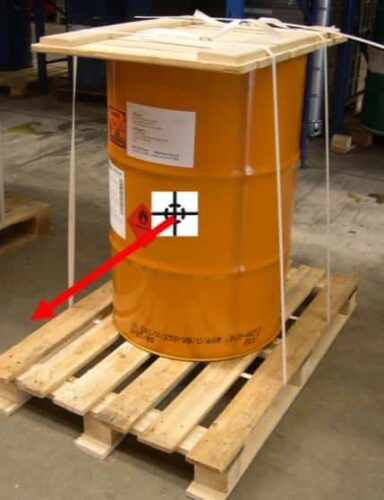
Strapping a single drum is critical because the strapping moves away from its optimum line due to the vibrations during transport and becomes loose as a result.
The edge protection bracket cannot prevent this.
The pre-tension is lost and the drum is no longer secured.
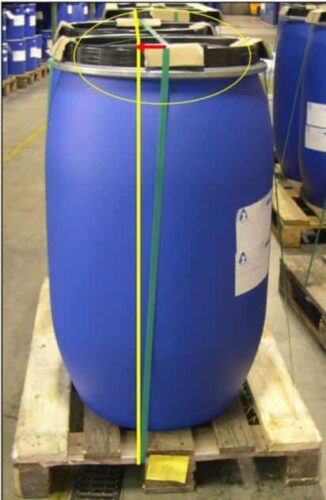
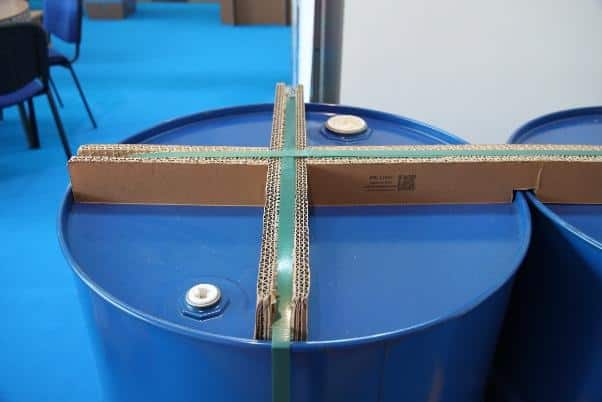
The simplest solution would be a cross made of boards on the drum, over which the strapping would then run.
The circumference of the straps would be fixed and could no longer change, so the pre-tension would not be lost.
A non-slip pallet support would always be an advantage, especially with plastic drums.
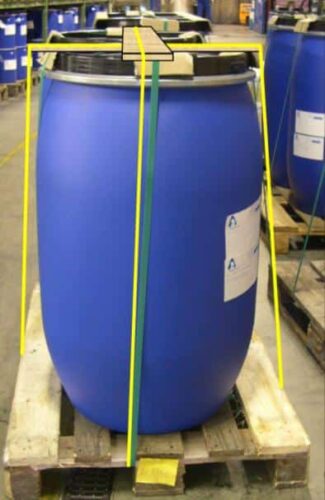
The purpose of this anti-slip coated layer made of honeycomb cardboard is that it specifically tears during strapping and thus prevents the strapping from slipping.
The circumference remains stable so that the preload is not lost.
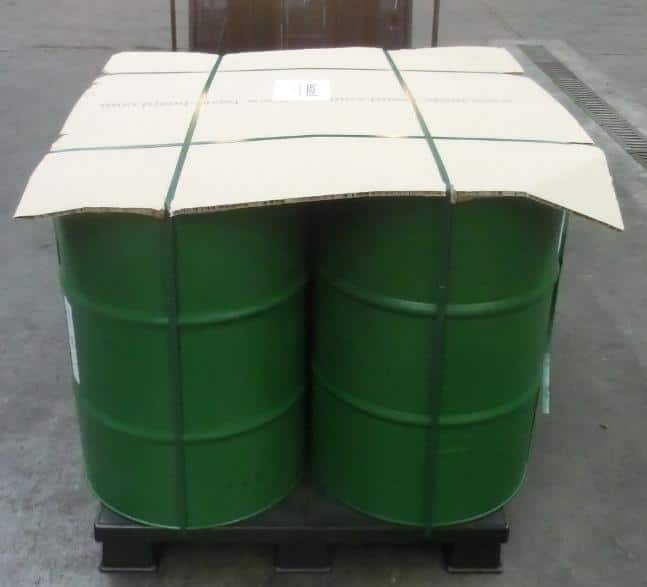
This barrel cross is an elegant solution.
This is also available for plastic barrels and in different versions from one to four barrels.
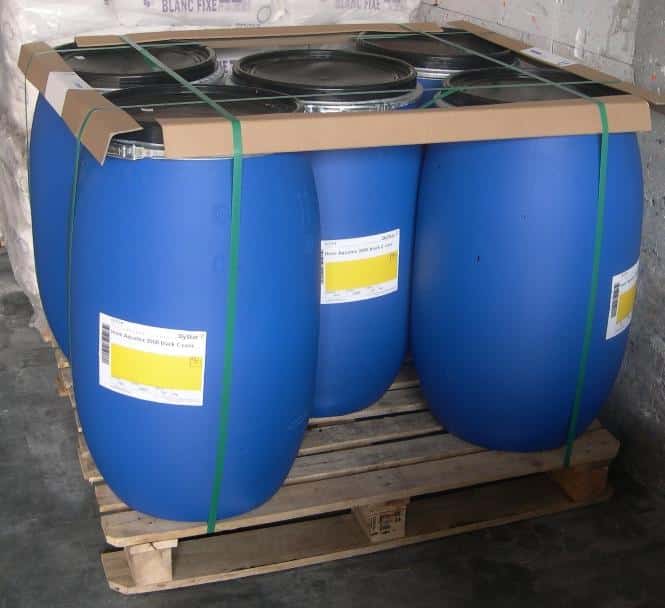
If there are several drums on a pallet, edge protectors are a good but costly solution because four straps are always required to stabilize the load unit.
A number of boundary conditions must be observed when using strapping.
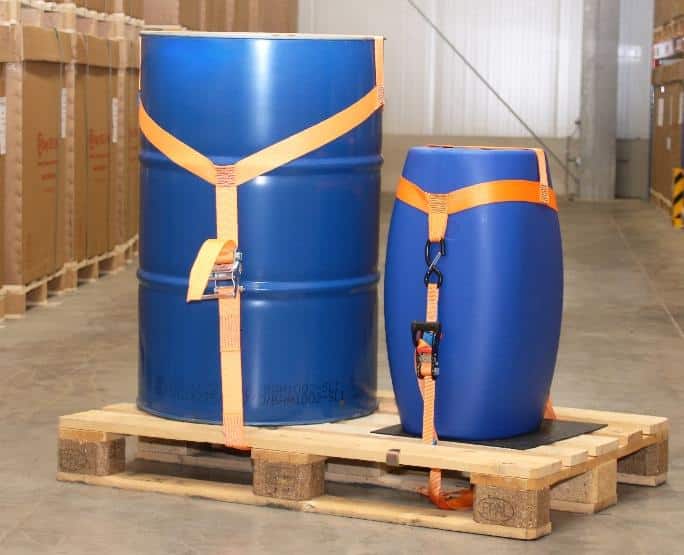
This problem is solved with ready-made strapping systems.
They are available for various standard drum sizes and are reusable.
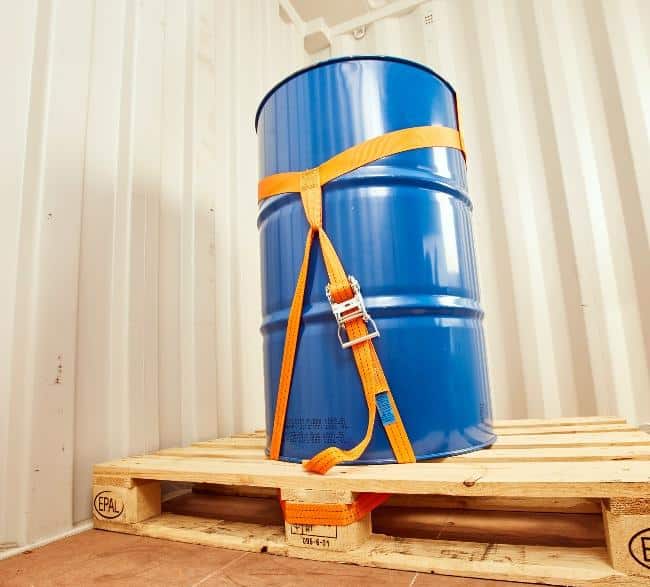
The coefficient of friction with the pallet is very low, especially with plastic drums.
During normal strapping, they can come loose from the securing device due to the greater elongation of the strap (>10%).
With webbing systems, the elongation is less than 7%, which is why this risk is close to zero.
In addition, the time required for securing is less than for strapping.
Another good solution is the DrumGuard system.
The metal molded part grips the drum edges and connects them to the pallet via a long screw.
This is a positive locking system.
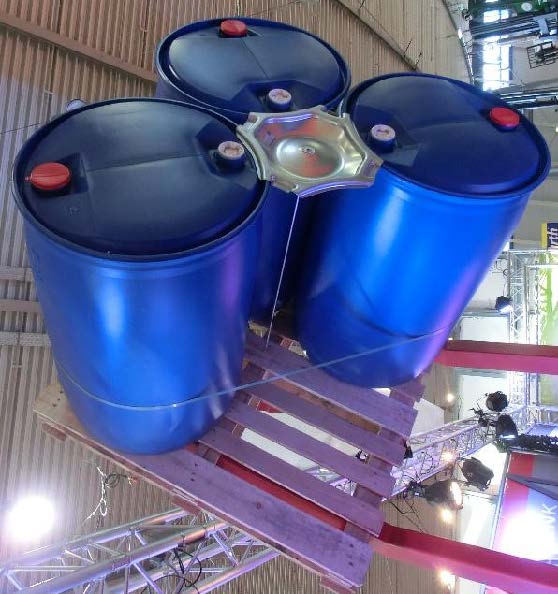
The solutions shown above are not exhaustive and new ones are constantly being added. It is therefore necessary to find out what is available on the market and to test one or the other option.
If you ask Mr. Goggle for the keyword “drum safety” and switch to “images”, you will be shown a whole host of situations and solutions. Visiting trade fairs such as FachPack in Nuremberg or LogiMat in Stuttgart are good opportunities for this.
As always, my descriptions are only intended to outline the topic, but not to cover it exhaustively. If you familiarize yourself with the task, you may find solutions that are simpler and better. Simply doing nothing increases the general risk during the transportation phase for everyone involved and this should be avoided at all costs.
Tackle it, it can only get better!
Yours, Sigurd Ehringer

<< Previous article
Episode 65 Mistakes when securing IBCs – best practice
Zum nächsten Beitrag >>
Folge 67: Sicherungsmethoden im Wandel der Zeit – 1934 bis heute
You are currently viewing a placeholder content from Vimeo. To access the actual content, click the button below. Please note that doing so will share data with third-party providers.
More InformationYou are currently viewing a placeholder content from YouTube. To access the actual content, click the button below. Please note that doing so will share data with third-party providers.
More InformationYou need to load content from reCAPTCHA to submit the form. Please note that doing so will share data with third-party providers.
More InformationYou are currently viewing a placeholder content from Google Maps. To access the actual content, click the button below. Please note that doing so will share data with third-party providers.
More Information