


At a Glance:
This article highlights the simple tools and methods that can be used to address the issue of transport racks and find company-specific solutions.
Often, suitable tie-down points are missing, or the size of the racks does not match the load carrier.
The various perspectives on the risks and challenges are supplemented with proposed solutions.
All three terms include the word “frame.” If you ask Mr. Google, the AI immediately provides the following information: “According to the Wikipedia entry on ‘frame,’ a frame is a structural element or piece of furniture that bears weight, provides support, or organizes items.”
In a logistics context, one could replace “piece of furniture” with “shelf.” The word “transport” does not appear in this explanation because it assumes a stationary application. This is precisely what my term “problem load” refers to.
In my experience, there are many industries that use racks. Examples include the construction and automotive industries, as well as companies that supply parts for mass production.
What is the difference?
Bearings are installed once, remain stationary, and the components they support are not subjected to significant accelerations.
Loading racks help, for example, with the transfer of bulky goods from one storage location to another. Accelerations occur in the vicinity of industrial trucks, which exert forces on the components.
Transport racks are designed for the transport of goods by road, sea, rail, or air. In these applications, much higher accelerations—typical for each mode of transport—occur, far exceeding those experienced by industrial trucks.
That is precisely the crux of the matter: racks that are actually designed and sized for the warehouse are being used for transportation.
I would like to describe the following points in a little more detail below:
1.) The racks do not have any tie-down points to secure them to the vehicle.
2.) The racks have no or insufficient securing mechanisms to compensate for cargo movement within the rack caused by acceleration.
3.) The dimensions of the racks do not fit within the standard grid dimensions of the transport vehicles, making form-fit securing difficult or impossible.
4.) In order to secure the racks—including their load—nevertheless, the cargo is often subjected to stress from the securing forces. As a rule, the cargo is not designed to withstand this stress.
Re 1.) The transport rack does not have any tie-down points for securing it on or inside the transport vehicle. If the dimensions do not fit within the transport vehicle’s grid dimensions, securing the load will be difficult.
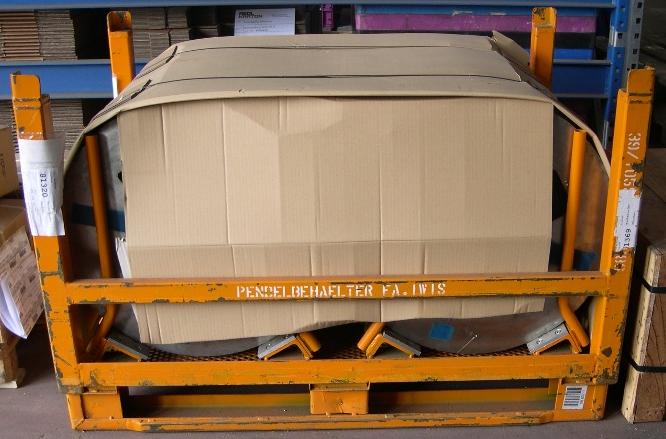
Re 2.) The transport rack must be equipped with fastening mechanisms to compensate for the resulting acceleration forces and prevent the cargo from moving. Secure fastening by form fit could potentially cause damage.
In the image, the cargo protrudes on both sides (red markings). The cargo is simply resting on the rack, but there are no securing devices in place.
Conclusion:
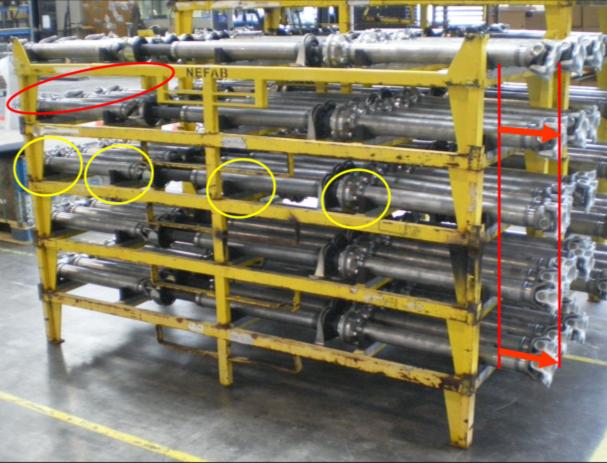
Re 2.) This transport rack does not fit within the grid dimensions of a truck, either lengthwise or crosswise. It is therefore necessary to secure each individual rack. Often, the only option is to lashing it down, but this is generally the worst method.
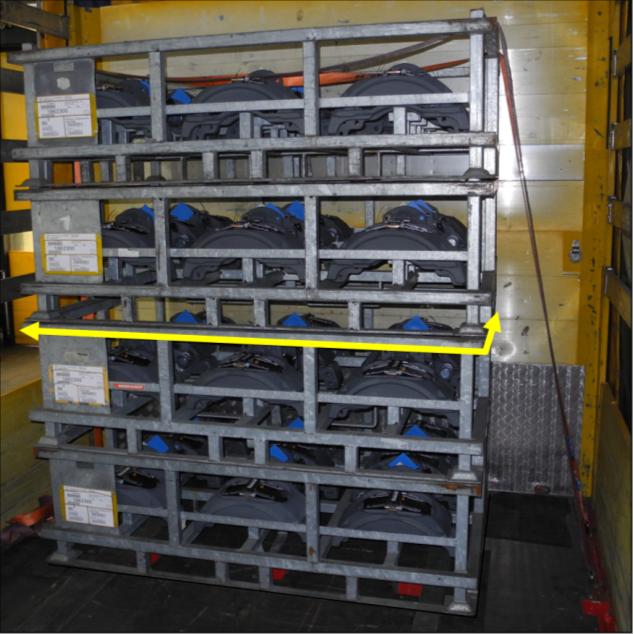
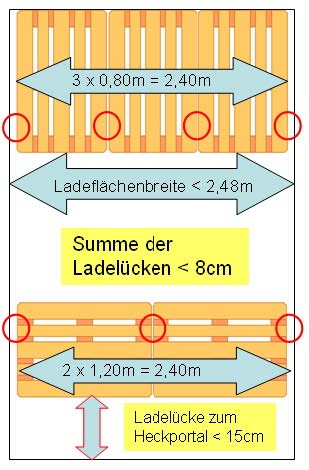
Conclusion: The loading areas of trucks are designed to fit the standard dimensions of a Euro pallet. This has the advantage that, as a rule, the load can be secured by a form-fit, at least on the sides and in the front.
Transport racks should be sized so that their length and width fit within the grid dimensions. A 70-centimeter-wide transport rack will always cause problems. Three side by side are too narrow; four side by side are too wide.
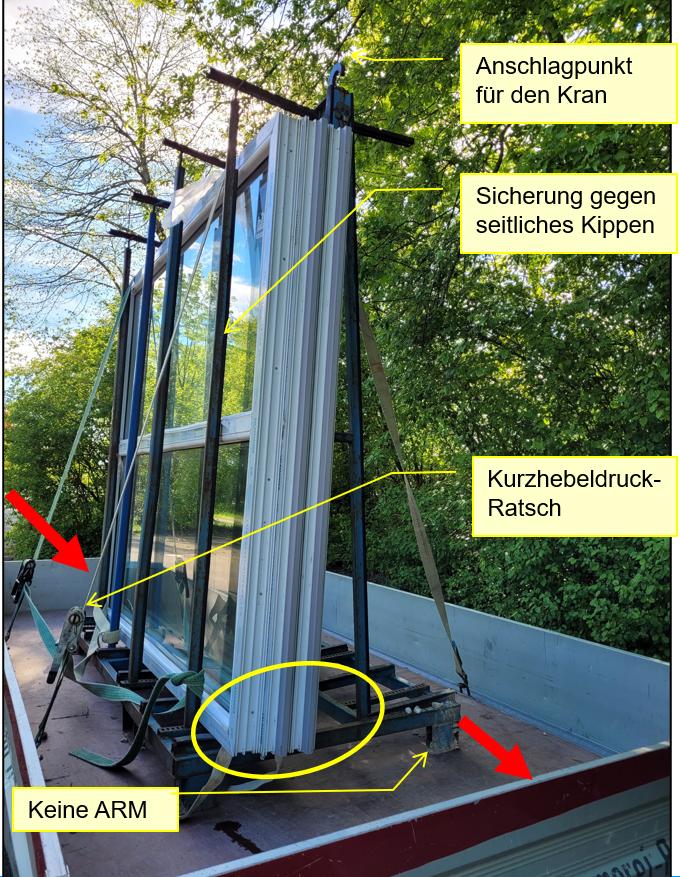
Re 4.) Aside from the lateral anti-tilt device, this transport rack has no other means of securing the load against longitudinal movement.
Anti-slip mats (ARM) were also not used.
There is no forward form-fit. The hooks on the top of the rack are designed for crane handling.
The load unit is secured solely by two Tie-down straps with short-lever ratchets. Experience shows that the straps are often tightened to the point where the cargo is damaged. However, the required securing force is frequently not achieved.
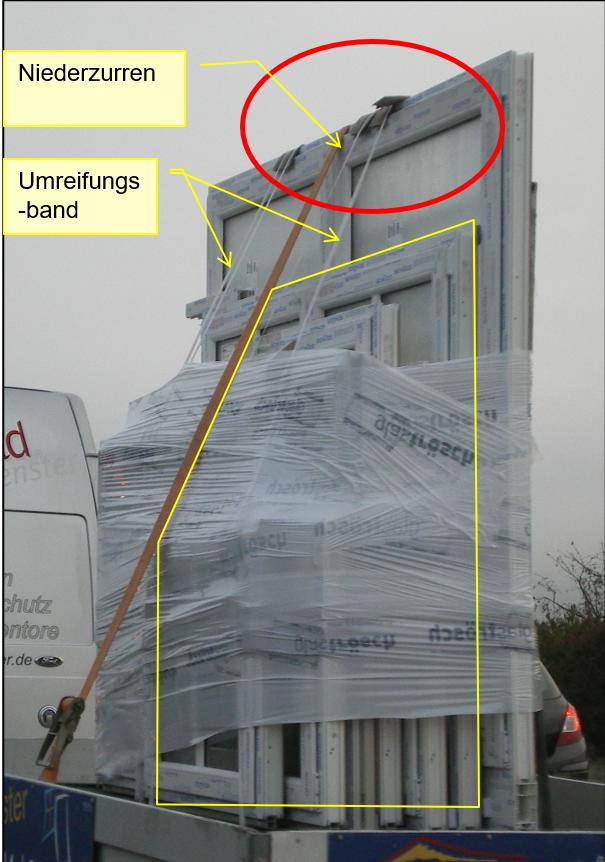
Another example regarding 4.) The picture shows that the transport rack is too small for the load. The load extends beyond the rack on three sides. Since there are no tie-down points, the load is secured by lashing it down (red circle).
The strapping does not generate enough holding force to keep the load (yellow line) secure on the transport rack in the event of an emergency stop.
These are likely windows and doors for a construction project—that is, one-of-a-kind items—and the time required to replace them in the event of damage will be correspondingly long.
Windows and doors are generally heavy cargo. It is doubtful whether the preload force resulting from the total weight (transport rack + cargo) is sufficient to secure them.
Conclusion:
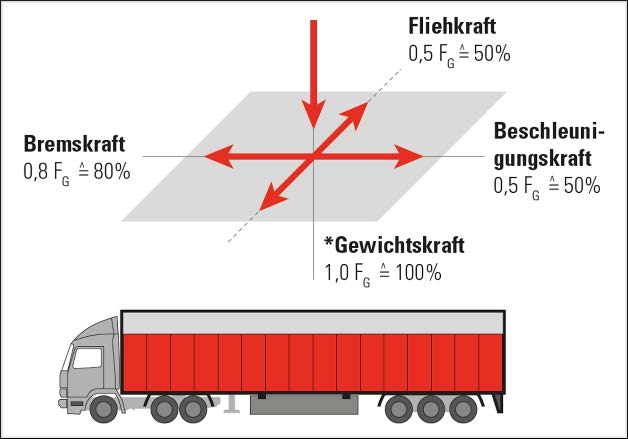
These are the accelerations that must be taken into account during road transport. They affect every single item in the load.
If gaps or spaces develop between items in the load or between the load and the vehicle, the cargo will shift as far as possible.
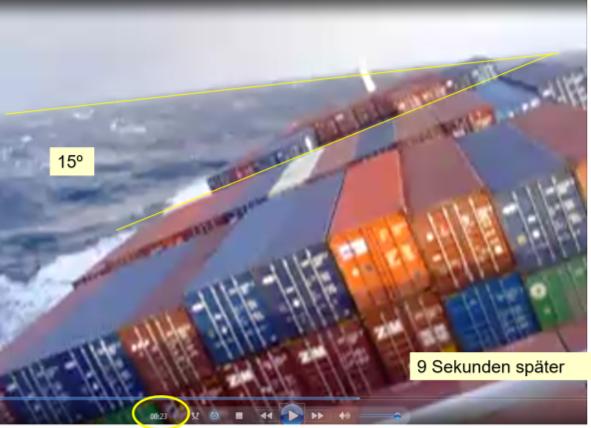
When transporting by container, it is particularly important to note that, unlike in a truck, the maximum acceleration occurs perpendicular to the direction of travel.
The 0.8 g corresponds to a roll angle of approximately 38° with a roll period of 2–3 times per minute.
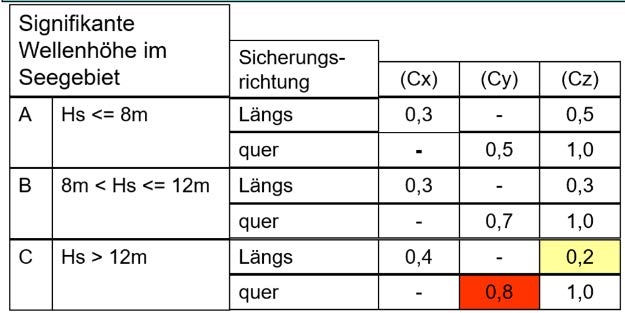
Taking into account the accelerations that occur, it may be advisable to equip the transport rack with a sturdy end panel on one side and to secure the cargo to it using a form-fit connection.
To this end, a mark indicating the loading direction should be affixed to the transport rack to minimize movement of the cargo and thereby prevent damage during transport.
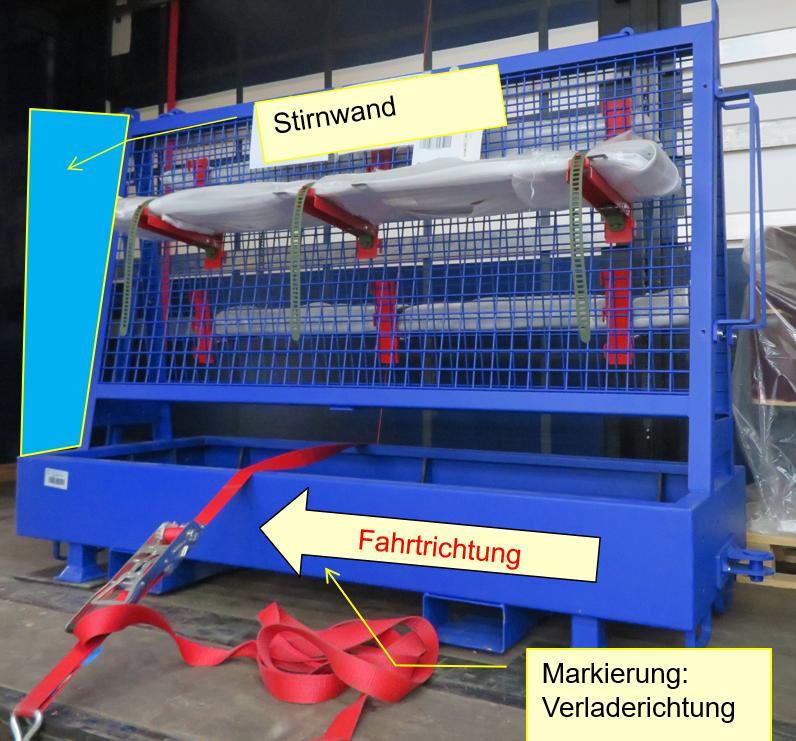
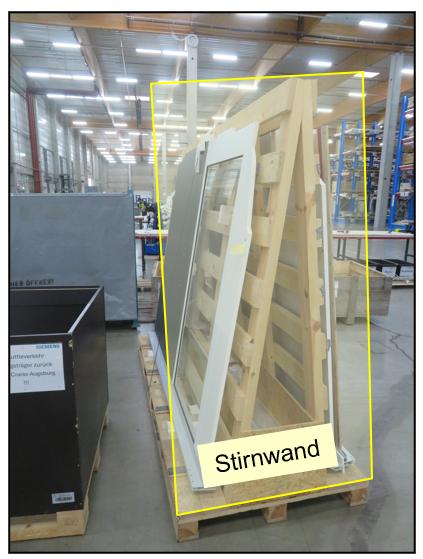
This applies in general to all transport racks, especially the so-called A-frames used to transport flat cargo. Here, too, the loading direction must be specified.
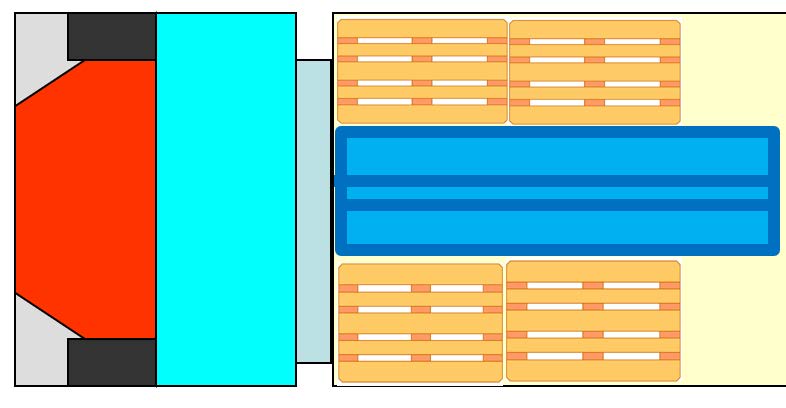
The dimensions of the transport racks should be designed so that they fit lengthwise or crosswise within the Euro grid dimensions.
Example: A transport rack that is more than 2.40 m long and 0.80 m wide could be loaded lengthwise in the direction of travel and secured on both sides using Euro pallets to ensure a snug fit.
Securing the sides with straps would then only be necessary if there is a risk of tipping.
To prevent damage during transport and ensure that the load is secured efficiently and safely, everyone in their respective areas should check the loading/transport racks for suitability. As a general rule, the movement of the cargo within or on the transport rack—relative to the rack itself—must be prevented.
As always, my explanations are intended only to touch on the topic, not to cover it exhaustively. Those who familiarize themselves with the task at hand may find solutions that are simpler and more effective. Simply doing nothing increases the overall risk for everyone involved during the transport phase, and that should be avoided at all costs.
Get to work—things can only get better!
Yours, Sigurd Ehringer
<< Back to the previous post
Episode 72: Language Barriers in Logistics—What to Do

You are currently viewing a placeholder content from Vimeo. To access the actual content, click the button below. Please note that doing so will share data with third-party providers.
More InformationYou are currently viewing a placeholder content from YouTube. To access the actual content, click the button below. Please note that doing so will share data with third-party providers.
More InformationYou need to load content from reCAPTCHA to submit the form. Please note that doing so will share data with third-party providers.
More InformationYou are currently viewing a placeholder content from Google Maps. To access the actual content, click the button below. Please note that doing so will share data with third-party providers.
More Information