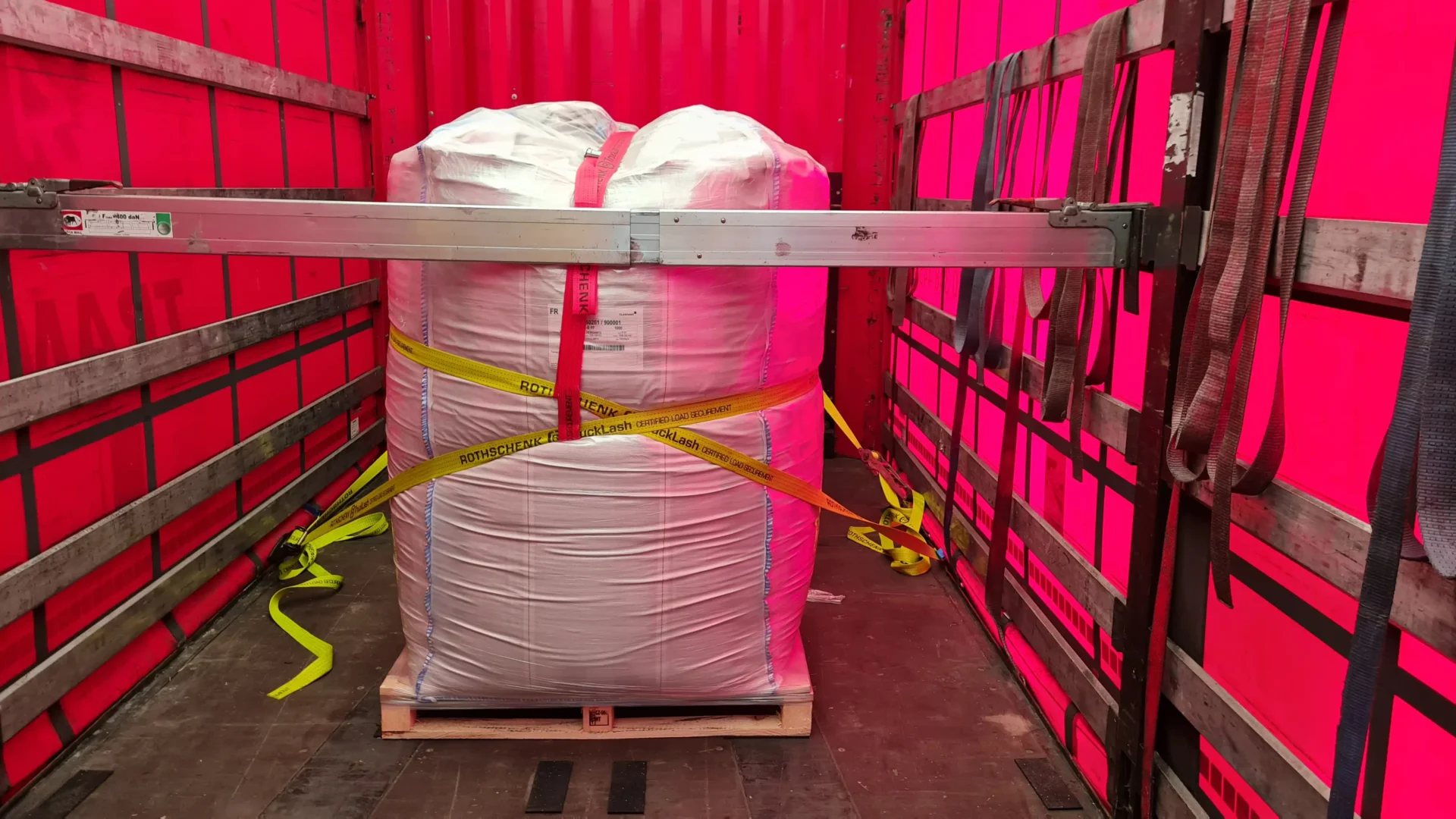


As previously announced, in this blog post I would like to focus on the “lashing down” securing method and examine it in more detail.
To illustrate the connection, here is the chart from Episode 67 again.
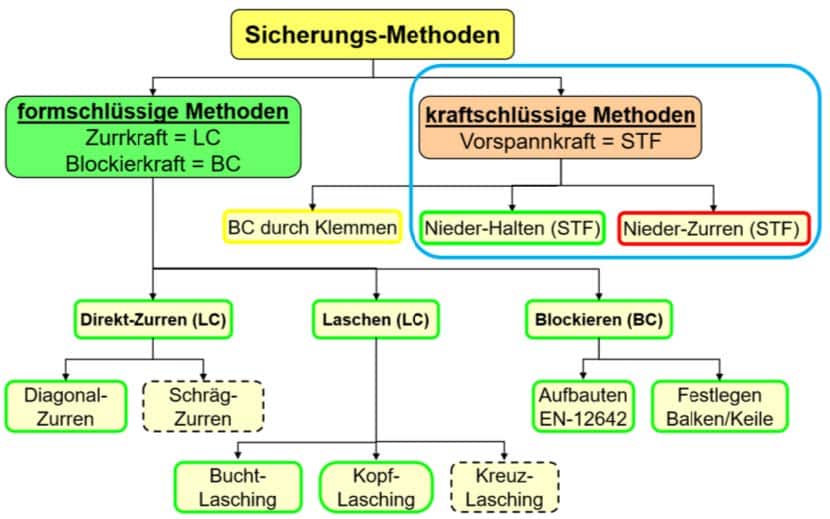
Today, out of the many possible securing methods, we’ll focus only on the area outlined in blue. In other words, lashing down and securing. The most common types of cargo are secured using lashing because it’s easy to do. “Throw the strap over the cargo, hook it in, tighten it—done.”
In fact, however, it is the method that requires the most boundary conditions to be taken into account, and thus also the one in which the most mistakes can be made.
The principle behind lashing is friction. This results in the following boundary conditions that must be observed:
Let’s now consider the individual boundary conditions:
1. The preload force
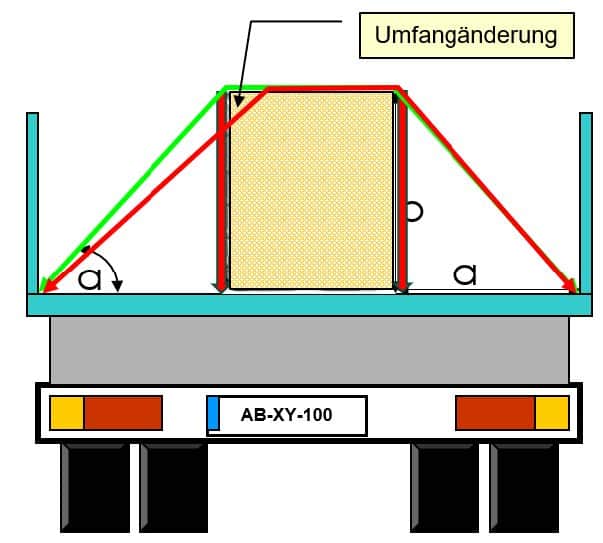
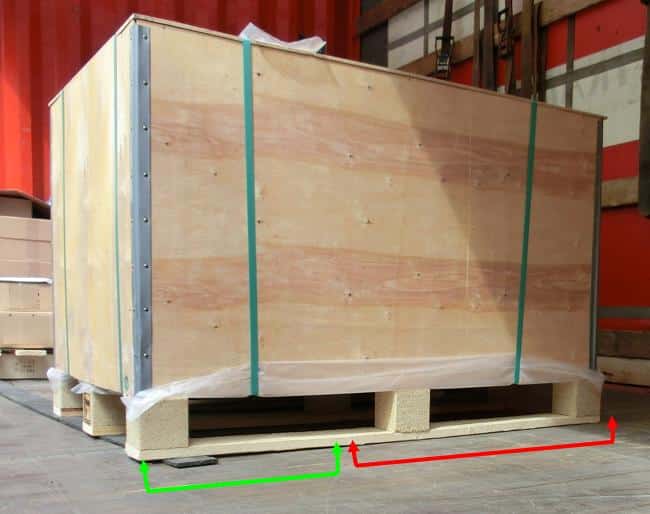
It must remain in contact at all times throughout the entire transport phase and must not be reduced by changes in the lashing circumference.
The initial lashing circumference (green line) changed during transport and became shorter (red line). However, the strap length between the lashing points remains the same, which is why the pretension force inevitably decreases.
Reduced preload force = load not secured.
1a. The Type of Clamping Device
has a significant effect on the preload force. There are two variants:
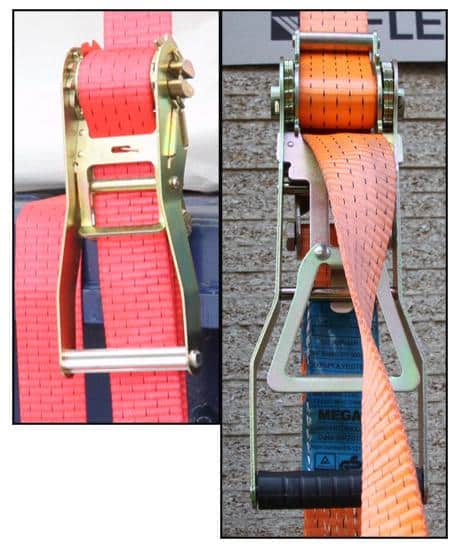
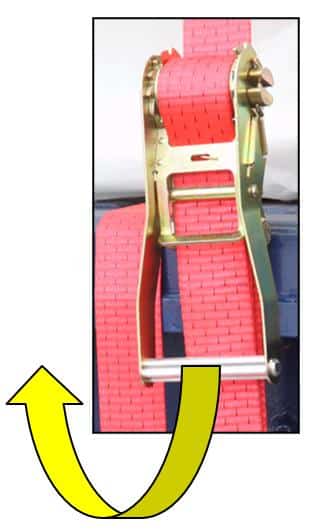
For the short-lever ratchet
The SHF (manual force) of 50 daN must be achieved by “pushing up” on the handle. Anyone can understand this problem by trying to push a 50-kg dumbbell upward with one hand.
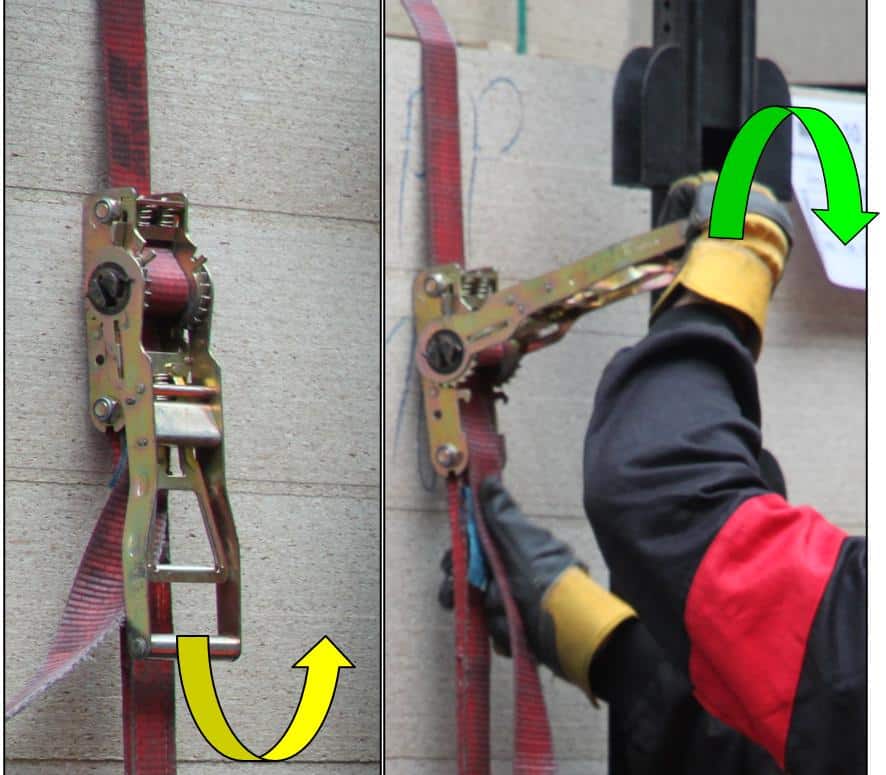
For the long-lever ratchet
The SHF (manual force) of 50 daN must be achieved by “pulling downward.”
In this process, the entire body weight is used to generate the pulling force. Experience shows that in most cases, body weight exceeds 50 kg.
Thus, the probability of reaching the specified SHF is significantly greater than with the short-lever pressure ratchet.
1b. The elongation of the webbing material
The pretension force has an impact, especially when the belt has not been stretched sufficiently due to insufficient pretension force.
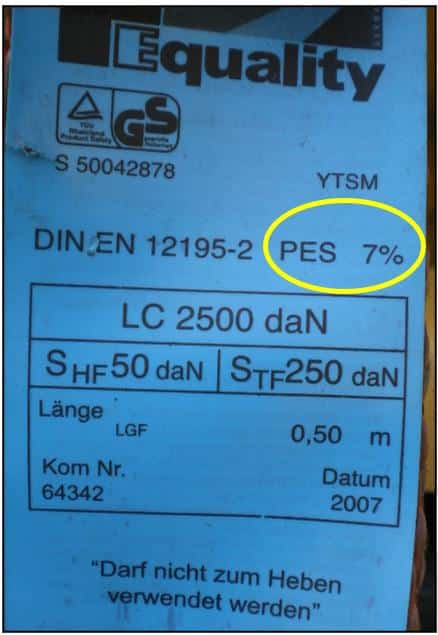
During transport, this evens out and the pretension force is lost. In the image, the belt has a 7% elongation.
This means that the strap material stretches 7 cm over a length of one meter. If we assume a lashing circumference of 4 m, that would be 28 cm. The scale is intended to illustrate the relationship.

1c. The number of deflection points
reduces the transfer of preload force from the ratchet side to the other end of the strap. This cannot always be avoided, but it must be taken into account—for example, by applying a safety factor.
2. Friction
The friction between the load/load carrier and the loading surface should be as high as possible. The coefficient of friction is denoted by μ.
The certificates issued by trailer manufacturers typically specify a coefficient of friction of μ=0.3 for the screen-printed floor.
Calculation example:
A load weighs 1,000 kg to 1,000 daN.
With a coefficient of friction of μ = 0.3, the frictional force would be 1,000 daN × 0.3 = 300 daN.
Since no specific measures are mentioned, it can be assumed that a coefficient of friction of approximately μ = 0.3 can be achieved by thorough sweeping.
Key phrase: “spotlessly clean cargo area.”

2a. Slip-resistant material
Using it to increase the coefficient of friction can certainly make sense. However, it must comply with the requirements of VDI-2700, Part 15, “Slip-Resistant Materials.”
The required properties, such as elongation at break, are specified there. Not everything that is offered meets the specifications.
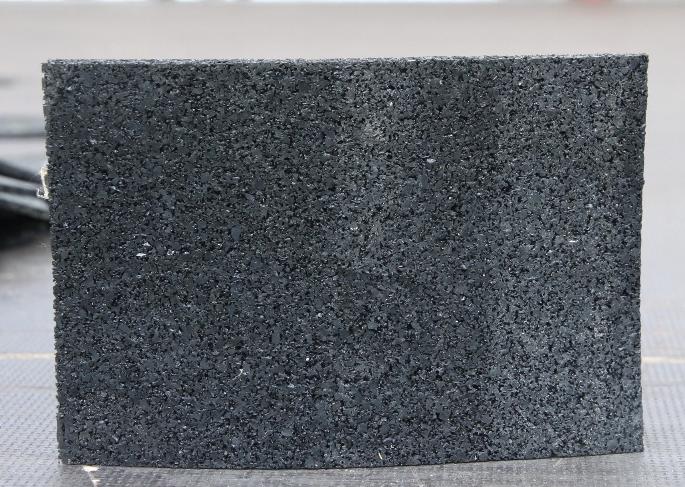
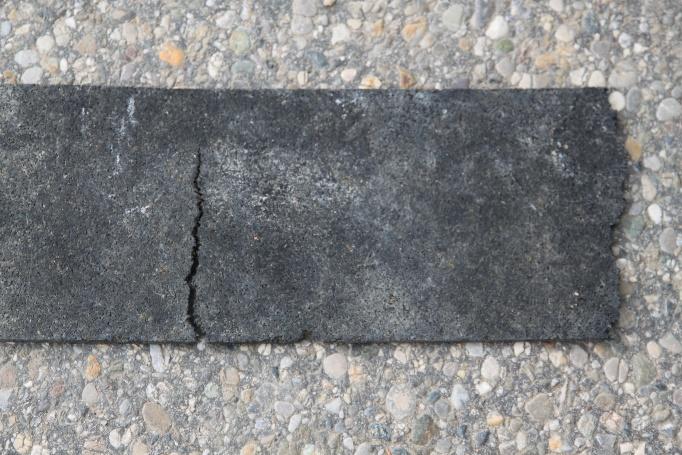
Construction protection mats or scraps of conveyor belts, as shown in the picture, are not included.
The picture shows an ARM in poor condition because it is frayed due to insufficient elongation at break.
According to VDI, the coefficient of friction is typically μ = 0.6, provided that the loading area is swept clean.
The positive difference is easy to see.
Calculation example:
A load weighs 1,000 kg to 1,000 daN.
With a coefficient of friction of μ = 0.6, the frictional force would be 1,000 daN × 0.6 = 600 daN.
2b. Proper Use of Anti-Slip Mats (ARM).
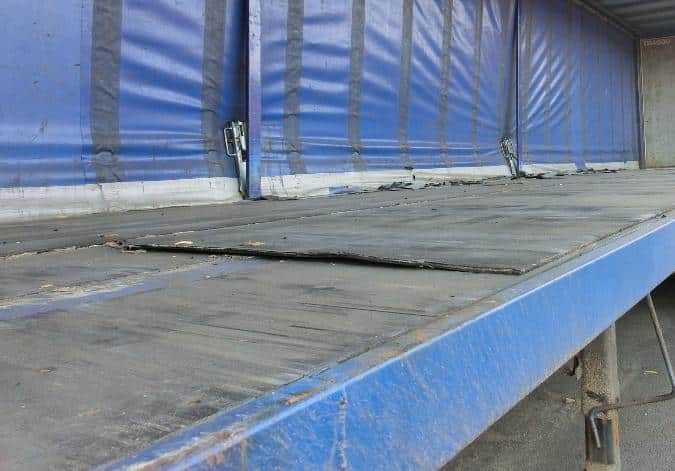
The most common mistake is placing the ARM on the dirty loading area.
The picture shows an exceptionally negative situation.

When using the ARM, the deformation caused by pressure must not exceed 20%.
In the picture, the mat was punched through because the contact area was too small. Therefore, you should always make sure that the surface pressure is not too high.
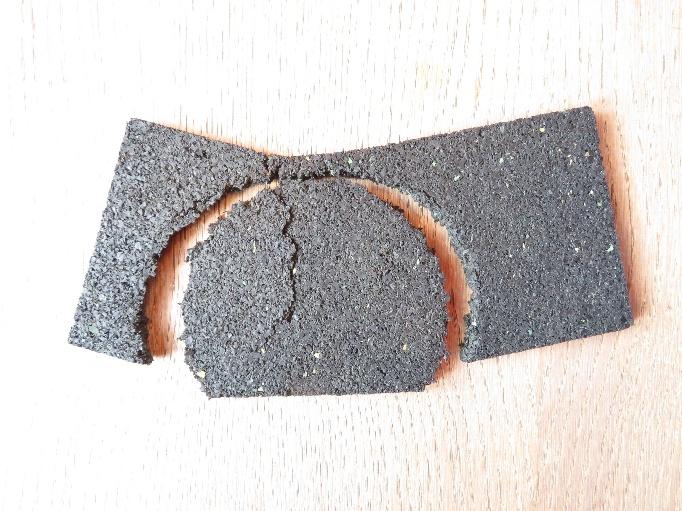
The situation shown in this picture indicates that the permissible surface pressure has already been exceeded.
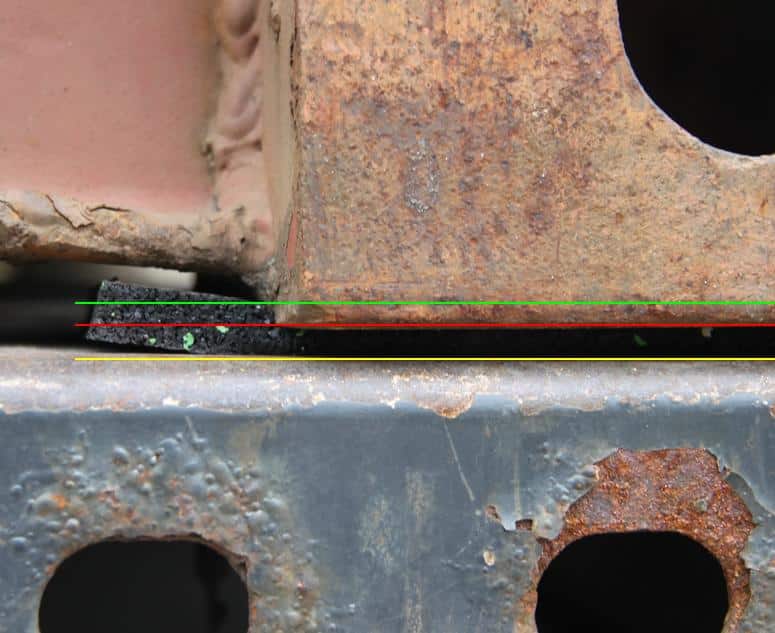
An ARM only achieves its maximum effect when the charge is completely separated from the charging surface via the ARM. “Decoupled” is the correct term.
Only in the green zone is there an increased coefficient of friction. In the red zone, there is contact with the loading surface. The load carrier is not decoupled.
Test drives would show that the loading unit rotates around the green zone because the coefficient of friction is lower in the red zone.
Situations like these and a dirty cargo area are the most common mistakes.
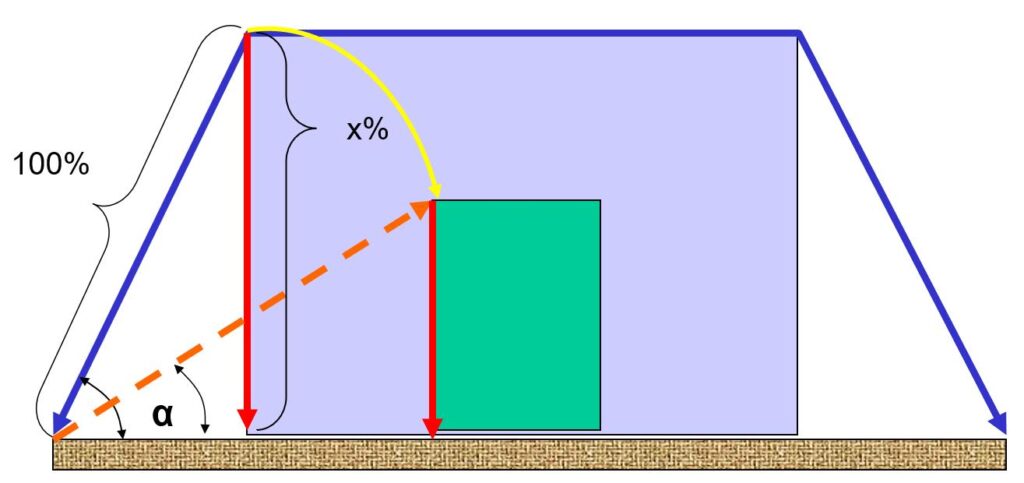
Only the red vertical arrow represents the effective preload force that secures the load. The flatter the angle, the lower the securing force.
The most common mistakes occur because neither the shipper nor the driver is aware of or understands the context.
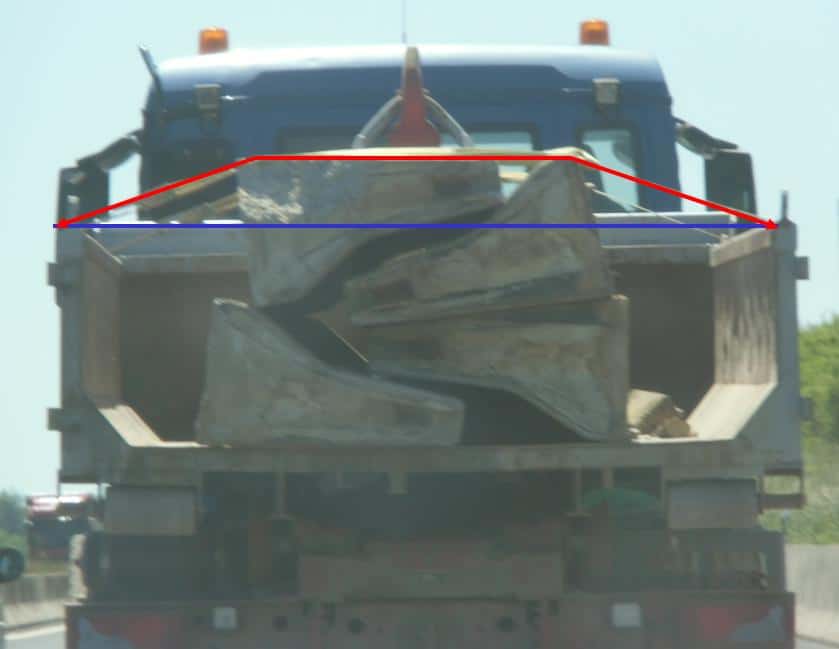
The situation captured in a recent photograph clearly illustrates this. The straps provide maximum protection against the load “flying away,” but not against the load shifting.
One criticism might be that
is an unsuitable vehicle because the cargo cannot be effectively secured due to a lack of tie-down points.
This is one of the formulas specified in VDI-2700 that can be used to calculate the required pretension force for lashing down.
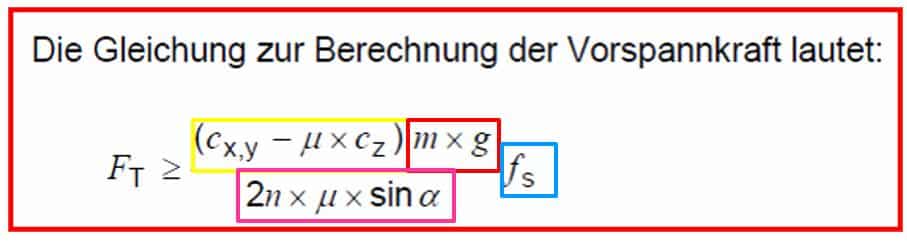
The yellow box illustrates the relationship between friction and acceleration. Cx,y is the value for acceleration parallel or perpendicular to the direction of travel.
μ is the coefficient of friction
Cz, the vertical acceleration due to gravity, 9.81m/s² ~ 1
Cx = 0.8 g; Cy = 0.5 g; μ = 0.3; Cz = 9.81 m/s² ~ 1
0.8 – 0.3 × 1 = 0.5
It follows that the effective acceleration in the direction of travel is 0.5 g in this case.
The red box represents the load weight used to calculate the inertial force based on the acceleration due to gravity.
m × g = 1,000 kg × 9.81 m/s² = 9,810 kg·m/s² = 9,810 N = 981 daN ~ 1,000 daN
For the following calculation, the acceleration due to gravity is rounded up to 10, and the load weight is 1,000 kg.
The purple box shows the effective pretension force as a function of the coefficient of friction and the lashing angle α.
For the following calculation, we assume a lashing angle α of 75°. The sine of this angle is 0.9659.
2n= are the two lashing angles α that typically result from lashing.
Because the principle of operation is “friction-based,” the coefficient of friction μ must also be taken into account here.
The function sin α is used to determine the vertical component of the pretension force.
The blue box contains the safety factor to account for uncertainties.
It is supposed to be 1.25.

The load weight of 1,000 kg must be secured with a pretension force of 539 daN. That’s the theory, anyway!
For this example, let’s use the belt with this label.
Given the low preload force of 250 daN, it is highly likely that it has a short-lever compression ratchet.
Let’s assume that the pretension force of 250 daN is actually achieved.
Under the assumed conditions, only 72 daN of this preload force remains.
Based on the assumptions above, the calculation would look like this:
FT = 250 daN × μ × sin α =
FT = 250 daN × 0.3 × 0.9659 = 72 daN
The number of straps can be determined by dividing the required holding force of 539 daN by the strap’s effective STF of 72 daN.
539 daN / 72 daN = 7.48 straps, which rounds up to 8 straps.
To secure a 1,000-kg load with this strap material, 8 straps would therefore be necessary. Many drivers and shippers will shake their heads and say that two straps should be enough.
If the truck has a standard lashing point layout in accordance with EN 12640, the first (1st) and last (8th) straps would be approximately 9 meters apart. However, the 1,000 kg might be on a single Euro pallet. In that case, the above considerations would be rendered moot.
If anyone uses a lashing calculator or app, they will notice that this boundary condition is not taken into account at all.
The“holding down”method differs from lashing in that the majority of the securing force is provided by anti-slip measures. The straps merely ensure that contact with the ARM is not lost due to varying vertical accelerations.
The detailed explanation is intended to show just how risky the “lowering” method is. Before using it, one should consider other securing methods or, at the very least, “holding down.”
As always, my explanations are only intended to outline the topic, but not to cover it exhaustively. If you familiarize yourself with the task, you may find solutions that are simple and better. Simply doing nothing increases the general risk during the transportation phase for all involved and this should be avoided at all costs.
Tackle it, it can only get better!

<< Back to the previous post
Episode 68: Documenting Load Securing – Tips and Tools
To the next post >>
You are currently viewing a placeholder content from Vimeo. To access the actual content, click the button below. Please note that doing so will share data with third-party providers.
More InformationYou are currently viewing a placeholder content from YouTube. To access the actual content, click the button below. Please note that doing so will share data with third-party providers.
More InformationYou need to load content from reCAPTCHA to submit the form. Please note that doing so will share data with third-party providers.
More InformationYou are currently viewing a placeholder content from Google Maps. To access the actual content, click the button below. Please note that doing so will share data with third-party providers.
More Information