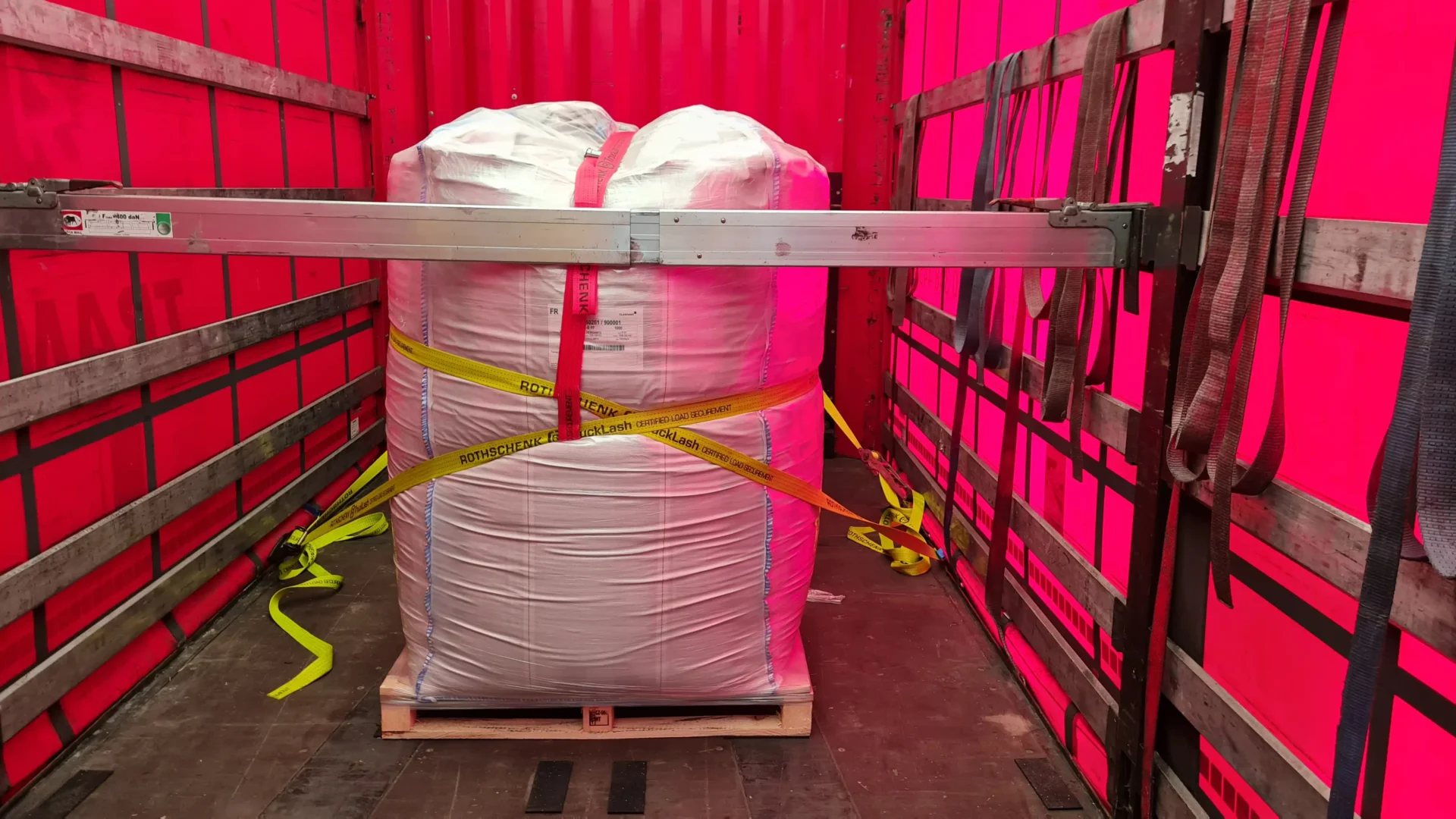


Many people may be familiar with the saying, “What’s written down stays,” and unfortunately, this is evident in the flood of emails we receive—which sometimes seem intended solely to reinforce the argument, “But I did inform you!!”
However, there are also many situations in which documentation is entirely reasonable, necessary, or even required. Load securing is one of them.
In various posts, I have already referred to VDI-2700 Sheet 5, “Quality Management Systems,” in light of Section 22 of the German Road Traffic Regulations (StVO), which states, “In doing so, the recognized rules of technology must be observed.”
In this Sheet 5, Chapter 4.1 states the following:
4.1 Responsibility
The operator shall establish structures that ensure responsibility for the proper securing of cargo is fully guaranteed and traceable. An organizational chart shall identify the departments or individuals to whom tasks and responsibilities are assigned.
Chapter 6.3 describes the types of controls and categorizes them as follows:
So the question is not “whether” controls are in place, but rather “how” they should be implemented.
On Wikipedia, the following activities are listed under the term “controlling”: managing, regulating, directing, and monitoring. Conversely, this means that there must be clear guidelines regarding what is to be managed, regulated, directed, and monitored.
I’d like to explain this idea using the following example. Most homemakers who want to bake a cake find a recipe, gather the ingredients, measure them out according to the instructions in grams or liters, mix them, let the batter rest for the specified time (minutes/hours), and bake the cake in the oven at the specified temperature (degrees) and for the specified time (minutes/hours). If the cake doesn’t turn out right, she can check whether: all the ingredients were used, the quantities were correct, the resting time was observed, and the oven temperature and baking time were correct.
A fundamental prerequisite for inspections is therefore the existence of clear guidelines, and many inspections of load securing fail precisely because of this. Time and again, I read the phrase “sufficient securing equipment must be provided” in instructions. What is the inspector supposed to do now? What does he or she—or anyone else—consider “sufficient”?
If the specification were: 10 lashing straps with long-lever ratchets; LC=2,000 daN; STF=500 daN; not due for retirement, then the inspection would be very simple.
The loading crew has an easy job when the loading procedure consists of four parts:
Explanation
1. Vehicle Specifications
The vehicle specifications should include a detailed description of:
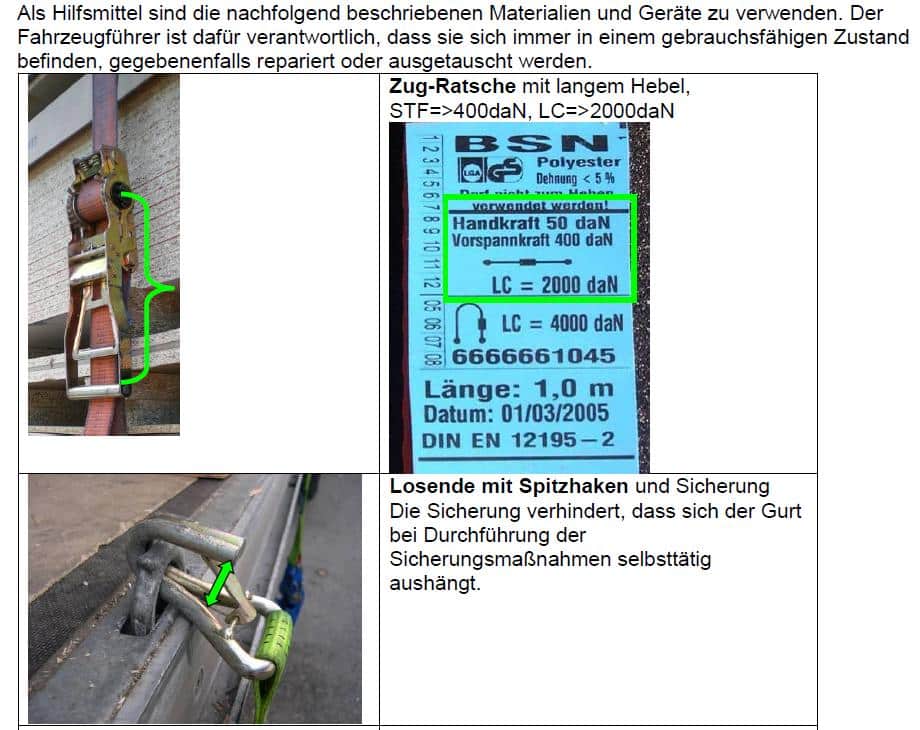
2. Loading Procedure
In my practice, I have found it helpful when instructions consist of clear images and brief text.
Securing methods can also be presented and verified in this format, as the following example shows:
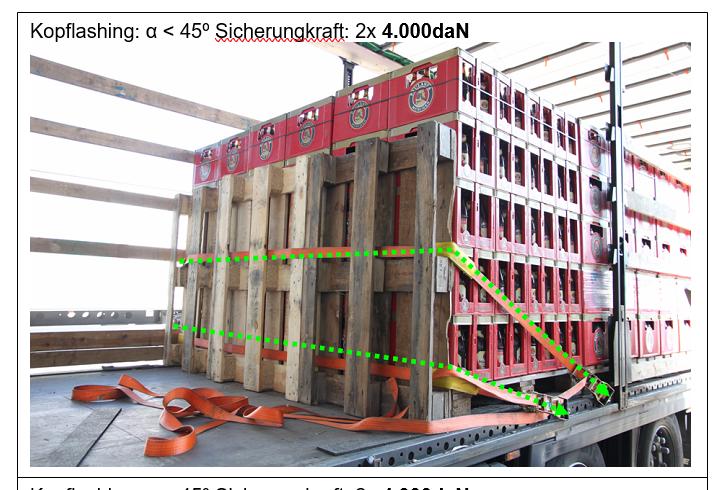
Depending on the load weight, the prescribed method must include the necessary securing measures to ensure compliance with §22 StVO.
In the example above, it is possible to verify at a glance whether two tensioning straps were used for securing the load and whether the lashing angles were observed.
3. Monitoring of the measures
There are two stages to consider here.
4. Documentation
The purpose of documentation is to preserve “evidence.” This can include, for example, proof that all products were loaded, as well as proof that the cargo was properly secured. In an age when available file storage space is no longer an issue, photographic documentation is one option.
Unfortunately, people often just “snap” pictures rather than “take” them, with the result that while there are photos, they are of little or no value. If this approach is used, there must be clear instructions specifying exactly which photos are to be taken from which angles for each loading operation.
The following diagram illustrates the basic concept, which requires that at least 5 photos be available for each shipment. Each phase can be supplemented with detailed photos, always with the goal of moving from the big picture to the details, depending on the intended purpose.
Step 1:
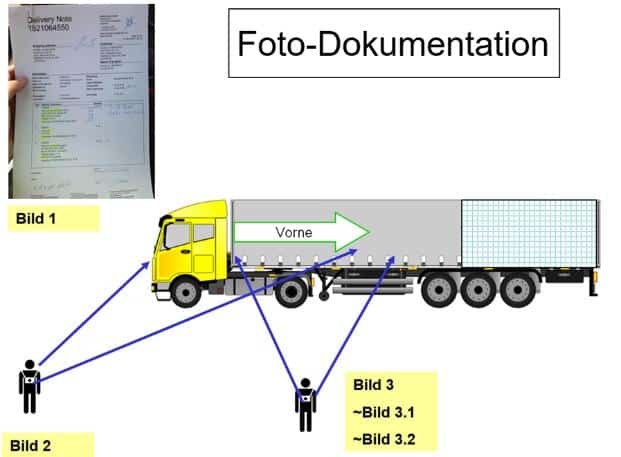
Step 2:
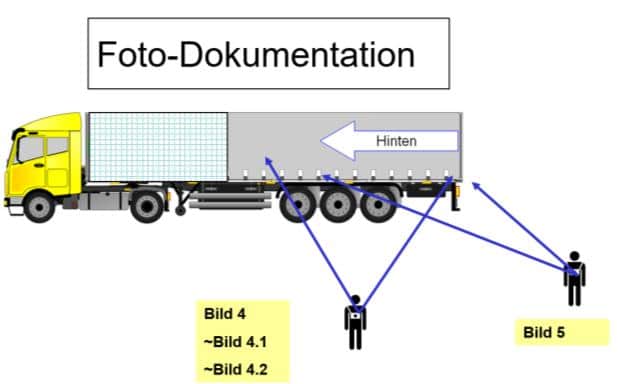
It is important to document the license plate numbers so that you can prove that the goods were transferred, if necessary.
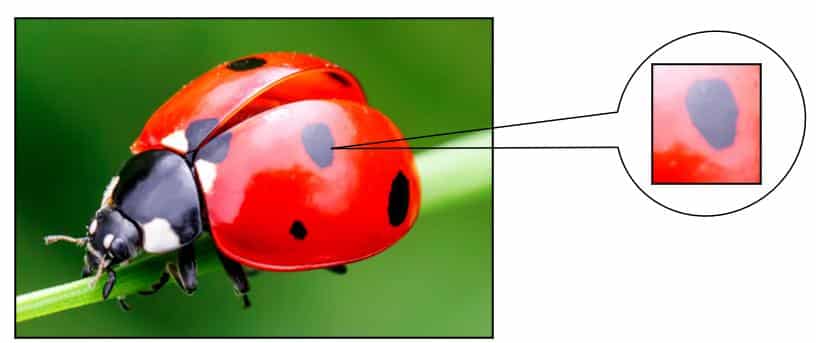
Each phase can be supplemented with detailed photos, always with the goal of moving from the big picture to the details.
Example: You can infer the image on the right from the one on the left, but not the other way around.
Of course, there are now digital solutions available—such as mobile apps—that simplify the processes and make it easier to organize items, especially images. However, it is not always clear whether the programmer or the client has fully understood the problem at hand.
That’s why you should make sure that your specific loading situation is accurately reflected in the app. Some apps are designed to be very general so they can accommodate as many situations as possible. That can be useful, but it isn’t always the case. You also shouldn’t let an app force you to adapt to its limitations.
There are no detailed regulations governing how documentation should be prepared. Its purpose, should the matter go to trial, is to preserve evidence and thereby exonerate yourself. Imagine the following situation: The judge asks you what steps you took to prevent legal violations. You explain your line of reasoning to him in a coherent manner. The judge then says he would have done the same thing, because he understood your logical, step-by-step reasoning.
It is important to remember that inadequate load securing could lead to the worst-case scenario of “negligent bodily injury or negligent homicide.” To prevent this, thorough and comprehensive organization and documentation are of crucial importance.
As always, my explanations are only intended to outline the topic, but not to cover it exhaustively. If you familiarize yourself with the task, you may find solutions that are simple and better. Simply doing nothing increases the general risk during the transportation phase for all involved and this should be avoided at all costs.
Tackle it, it can only get better!
Yours, Sigurd Ehringer

<< Back to the previous post
Episode 67: Backup Methods Through the Ages – 1934 to the Present
To the next post >>
You are currently viewing a placeholder content from Vimeo. To access the actual content, click the button below. Please note that doing so will share data with third-party providers.
More InformationYou are currently viewing a placeholder content from YouTube. To access the actual content, click the button below. Please note that doing so will share data with third-party providers.
More InformationYou need to load content from reCAPTCHA to submit the form. Please note that doing so will share data with third-party providers.
More InformationYou are currently viewing a placeholder content from Google Maps. To access the actual content, click the button below. Please note that doing so will share data with third-party providers.
More Information